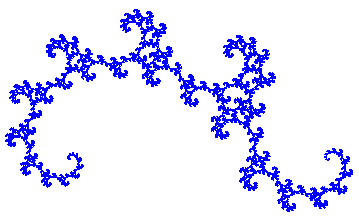

Heighway Dragon
Description
Construction
Animation
Geogebra
Animation
Construction via line segments
Begin with a line segment. As the first iteration, replace this segment with two segments, each scaled by a ratio \(r = \frac{1}{{\sqrt 2 }}\) in such a way that the original segment would have been the hypotenuse of an isosceles right triangle. Following along the original segment, we place the two new segments to the left. For the second iteration, replace each of the segments with two new segments at right angles, each scaled by the ratio $r$. The new segments are placed to the left then to the right along the segments of the first iteration. Continue this construction, always alternating the new segments between left and right along the segments of the previous iteration. This generates the "dragon curve". The following figure shows the first three iterations for this construction.

Each iteration can be represented symbolically by a sequence consisting of the letters R and L. One can imagine moving along the individual segments making up the curve start at the left endpoint. A 90° corner is labeled R if the curve makes a right turn there, and is labeled L if the curve makes a left turn at that corner. So the three iterations shown above are represented by the sequences R, RRL, and RRLRRLL, respectively. [Code Details]
Construction via paper folds
Here is how Heighway originally constructed the dragon. Fold a long narrow sheet in half. Fold again in the same direction (Example). Continue folding, always folding in the same direction. After several folds, open the sheet so that every fold is a right angle and view the sheet from the edge. In general, $n$ folds produces an order-n dragon. The following pictures show an order-3 dragon (left) and order-4 dragon (right) constructed from a narrow slice of a manila folder.
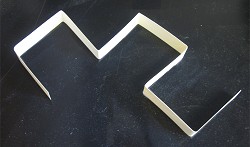
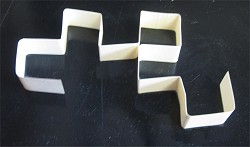
The same symbolic representation described above can be used to describe the sequence of folds. The order-4 dragon curve shown above is RRLRRLLRRRLLRLL. [More Code details]
Construction
Animation
Construction via triangles
For yet another way to construct the Heighway dragon, start with an isosceles right triangle $H_0$. Replace this triangle with two isosceles right triangles so that the hypotenuses of the new triangles lie on the equal sides of the old triangle. Working around $H_0$, starting from the left side, we place the first new triangle so that it points out from the old triangle and the other new triangle so that it points into the old triangle to get $H_1$. For the next step, repeat the process on each of the triangles that make up $H_1$, this time placing the new triangles so they point Out, In, In, Out, respectively, as illustrated in the figure below. This pattern of Out, In, In, Out is repeated for each subsequent iteration of the construction.
The Heighway dragon is the limiting set of this iterative construction. Notice that the line segments that make up the hypotenuses of the triangles form the same path as described in the first construction above.
Iterated
Function
System

IFS
Animation
where \(r = \frac{1}{{\sqrt 2 }}\). The attractor of this IFS will be the Heighway dragon. It consists of two self-similar pieces corresponding to the two functions in the IFS [Similarity Demonstration].

IFS
Animation
There is another way to visualize the action of this IFS. At each iteration, scale the current figure by \(r = \frac{1}{{\sqrt 2 }}\) and rotate by 45 around the origin. This is the same as function \(f_1\). Then make a copy of this figure and rotate it by 90° around the point (1/2,1/2). This will give an equivalent result as the function \(f_2\). Click the button to the left to watch an animation of the IFS iteration.
L-System
L-system
Animation
Axiom FX
F —> Z
X —> +FX−−FY+
Y —> −FX++FY−
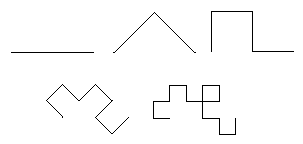
First four iterations of the L-system
Similarity
Dimension
\[\sum\limits_{k = 1}^2 {{r^d}} = 1 \quad \Rightarrow \quad d = \frac{{\log (1/2)}}{{\log (1/\sqrt 2 )}} = 2\]
Special
Properties

John Heighway

William Harter

Bruce Banks

In his column Gardiner wrote that "the curve vaguely resembles a sea dragon paddling to the left with clawed feet, his curved snout and coiled tail just above an imaginary waterline." Donald Knuth reported in his book about how Harter remarked to him that the iterations of the dragon in Michael Crichton's novel, Jurassic Park, are upside down or "as dead dragons". The Heighway dragon now appears in many different orientations depending on how it is drawn [See Examples].
Area
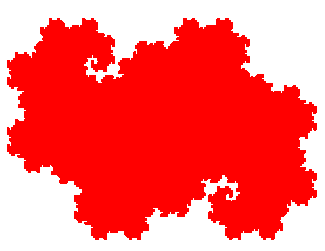
The Heighway dragon as described here starting with a line segment of length 1 has area 1/2 [Area Details]. If the initial line segment has length $b$, then the area of the Heighway dragon will be $b^2/2$ [see the derivation of area based on the Heighway boundary].
Bounding
Rectangle
The copy of the Heighway dragon below lies on top of a grid of size 1/6 by 1/6 with it's tail located at the origin. It demonstrates that the Heighway dragon lies within a rectangle with $-2/6 \lt x \lt 7/6$ and $-2/6 \lt y \lt 4/6$, i.e. a rectangle of width 1.5 and height 1 [Rectangle Details].

Tiling
The Heighway dragon can be used to tile the plane [Tiling Details].

Boundary
The boundary of the Heighway dragon is also a fractal with dimension 1.523627 [Boundary Details].

Components
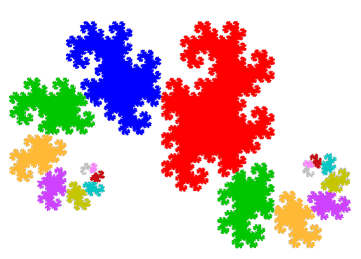
The Heighway dragon is composed of an infinite union of geometrically similar components that spiral around two curves ending at the endpoints of the initial line segment in the construction of the dragon. Each component consists of two copies of the dragon (forming a twindragon), one copy of the component scaled by 1/2 and rotated by 180°, and two copies of the component scaled by 1/4 [Component Details].
Space
Filling
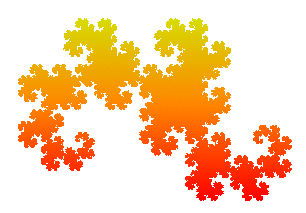
Let $H$ be the attractor for the IFS. There is a continuous curve $f$ defined on [0,1] such that $f([0,1]) = H$ and such that $f$ is a space filling curve. This means that $H$ has a non-empty interior. For a proof, see the book by Edgar. [Click for another example of a space filling curve generated by an iterated function system.]
Other Angles
Birth of a
Heighway Dragon
Animation
Similarity
to
Lévy Dragon
The construction of the Lévy dragon and the Heighway dragon are very similar. In each case one can start with an isosceles right triangle and replace this triangle with two isosceles right triangles so that the hypotenuse of each new triangle lies on one of the equal sides of the old triangle. The difference is how those new triangles are placed relative to sides of the old triangle. For the Lévy dragon, both are placed towards the "outside"; for the Heighway dragon, one is placed pointing out while the other is placed pointing in. Because of this similarity, it is perhaps not surprising that one can transform the Heighway dragon into the Lévy dragon through a continuous transformation. Indeed, for each t in the interval [0,1] define an iterated function system by
Heighway
to
Lévy
Animation
Let A(t) be the unique attractor of the iterated function system corresponding to the value t. Then A is a continuous function from the unit interval to the space of compact sets with the Hausdorff topology, with A(0) equal to the Heighway dragon and A(1) equal to the Lévy dragon. The animation shows A(t) as t goes from 0 to 1. Watch a one-minute YouTube video showing the transformation of the Heighway dragon into the Lévy dragon, and then back to the Heighway dragon (with a cameo appearance by the twindragon along the way.)
Variations

[See this design in back stitch]