
Heighway Dragon Components
Central
Component
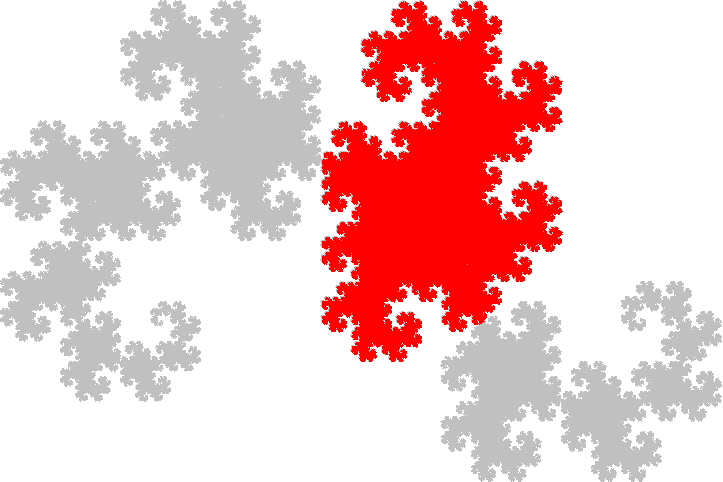
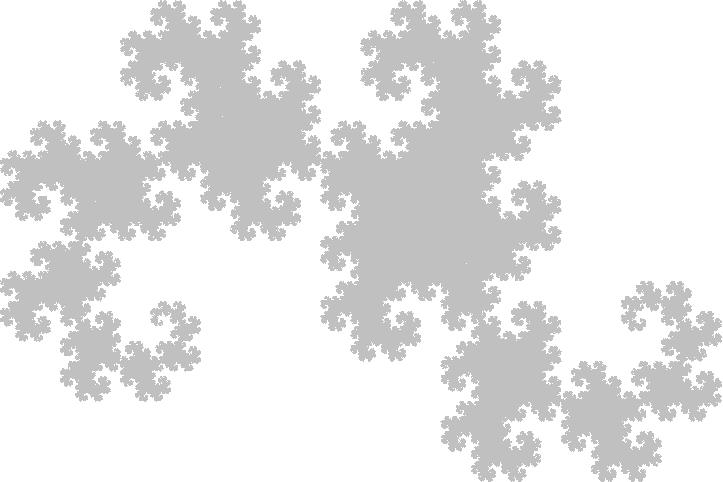
The red component consists of two copies of the dragon scaled by \(\sqrt{2}/4\), one rotated by 45° clockwise and the other rotated by 135° counterclockwise, one copy of the central component scaled by 1/2 and rotated by 180°, and two copies of the central component scaled by 1/4. The two copies of the dragon form a twindragon.


Cut points
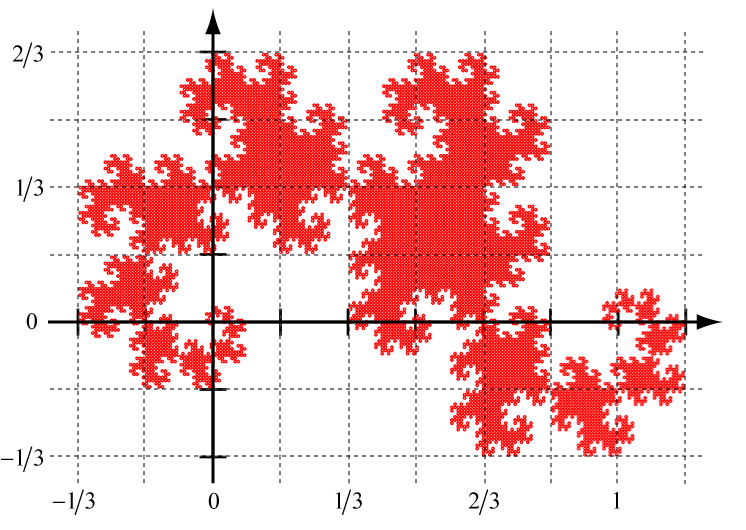
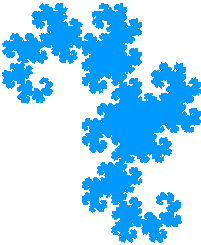
The cut points for the components to the left of the central component are located at \[\begin{array}{l} x_L(n) = \frac{\sqrt{2}}{3}\,2^{-n/2} \, \cos \left( (n + 1)\frac{\pi}{4} \right) \\ y_L(n) = \frac{\sqrt{2}}{3}\,2^{-n/2}\, \sin \left( (n + 1) \frac{\pi}{4} \right) \\ \end{array}\] for n ≥ 0. For the points in the figure, these are (1/3, 1/3), (0, 1/3), (-1/6, 1/6), (-1/6, 0), (-1/12, -1/12), (0, -1/12), (1/24, -1/24), (1/24, 0), (1/48, 1/48), and (0,1/48).
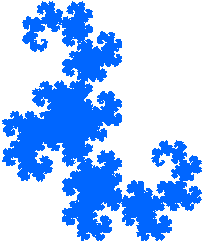
The cut points for the components to the right of the central component are located at \[\begin{array}{l} x_R(n) = 1 - \frac{\sqrt{2}}{3}\,2^{-n/2} \, \sin \left( (n + 1)\frac{\pi}{4} \right) \\ y_R(n) = \frac{\sqrt{2}}{3}\,2^{-n/2} \, \cos \left( (n + 1)\frac{\pi}{4} \right) \\ \end{array}\] for $n \ge 1$. For the points in the figure, these are (2/3, 0), (5/6, -1/6), (1, -1/6), (13/12, -1/12), (13/12, 0), (25/24, 1/24), (1,1/24) ,(47/48, 1/48), and (47/48, 0).
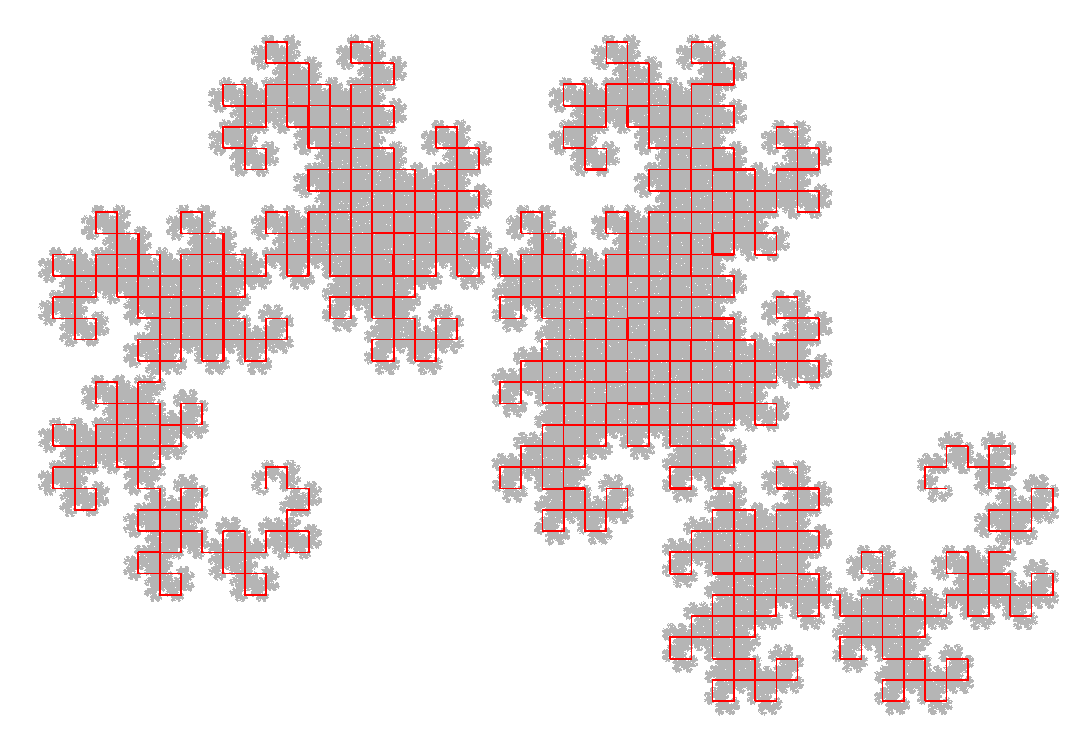
You can get a sense of why these cut points arise and where by looking at the 10th iteration of the Heighway dragon starting with the unit line segment from (0,0) to (1,0). In the figure below, where the iteration is superimposed on top of the dragon, the places where the segments do not enclose a complete square are the locations where the cut points will arise in the limit as the number of iterations goes to infinity.
Other
Components
Component
Animation
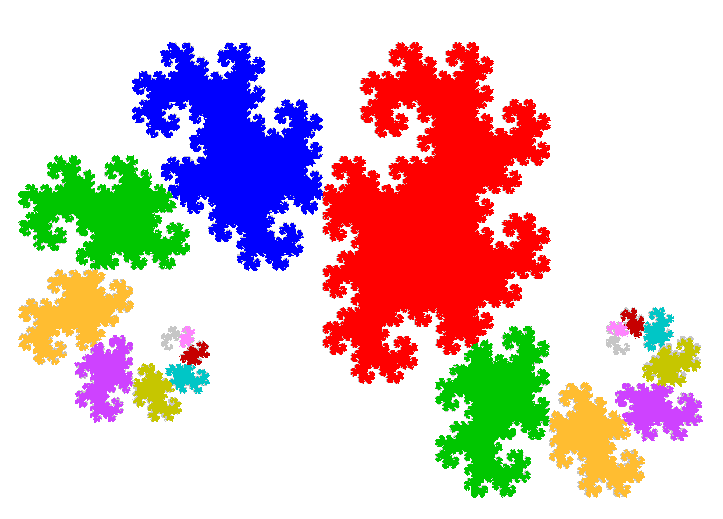
The figures below show how the components continue to repeat as you zoom in (going from left to right, as indicated by the square boxes). Click on each image for a larger view.
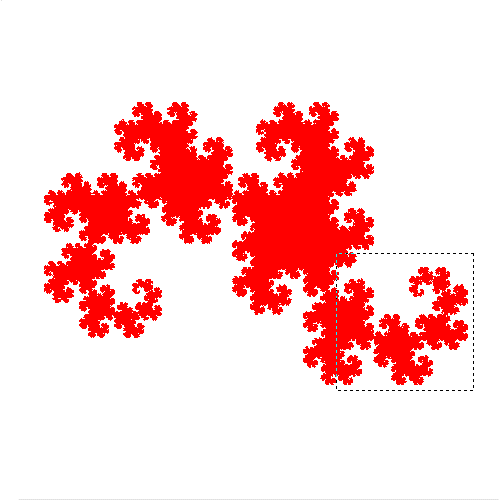
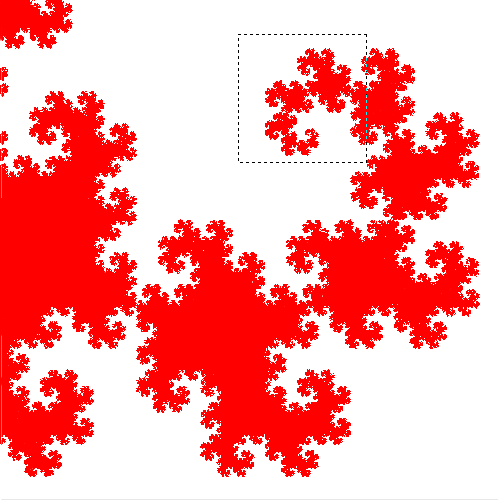
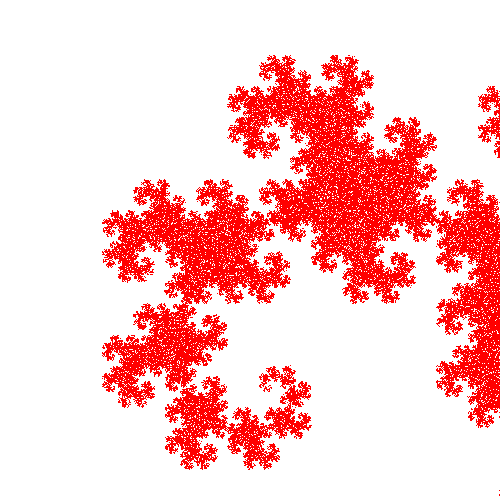
Component
Areas
Hence $A = (2/5)H$. The areas of the other components can be found by dividing by an appropriate power of 2.
We know that the central component of the Heighway dragon consists of 2 copies of the dragon, each scaled by \(\sqrt{2}/4\), one copy of the central component scaled by 1/2, and two copies of the central component scaled by 1/4. Taking the sum of the areas of these 5 pieces shows that
\[2\left( {\frac{1}{{8}}H} \right) + \frac{1}{4}A + 2\left( {\frac{1}{{16}}} \right)A = 2\left( {\frac{5}{{16}}A} \right) + \frac{1}{4}A + \frac{1}{8}A = \frac{5}{8}A + \frac{1}{4}A + \frac{1}{8}A = A\]Therefore the five parts of the central component must be essentially disjoint.