Barycentric Description of the Sierpinski Gasket
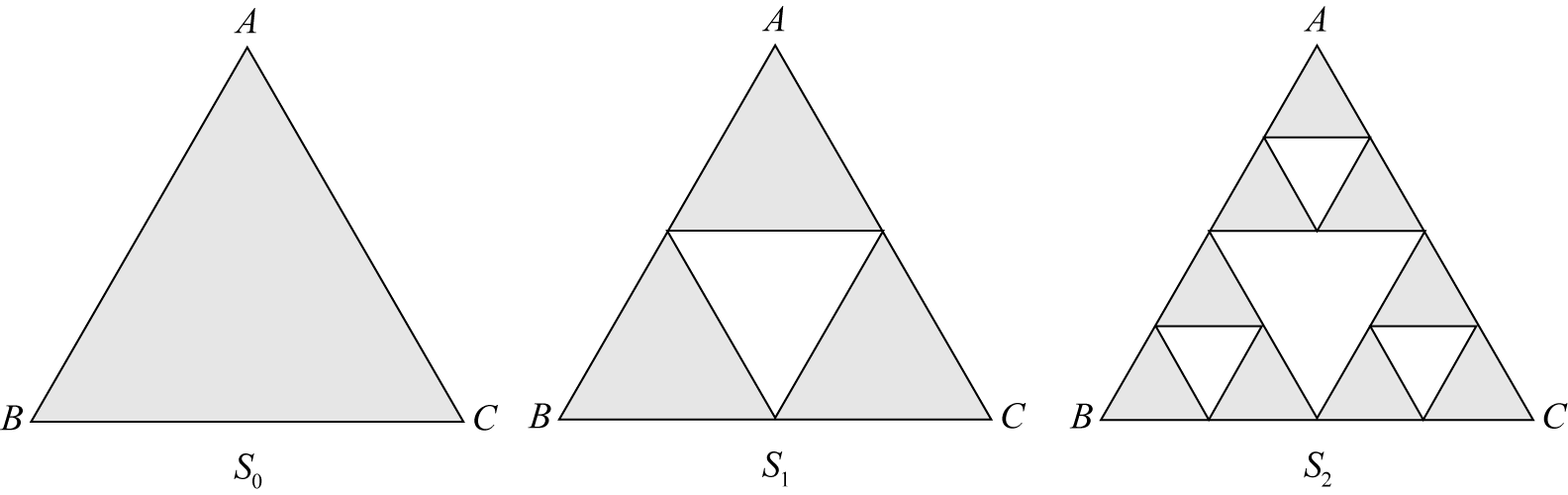
In a $\triangle ABC$, any point $P$ can be uniquely defined by its barycentric coordinates $(w_A, w_B, w_C)$. These coordinates represent the "weights" assigned to each vertex such that \begin{equation} P = w_A A + w_B B + w_C C \end{equation} subject to the constraint $w_A + w_B + w_C = 1$.
The barycentric coordinates of a point $P$ are the ratios of the areas of the sub-triangles \(\triangle PBC, \triangle PCA,\) and \(\triangle PAB\) to the total area of \(\triangle ABC\): \begin{equation} w_A = \frac{\text{Area}(\triangle PBC)}{\text{Area}(\triangle ABC)} \quad w_B = \frac{\text{Area}(\triangle PAC)}{\text{Area}(\triangle ABC)} \quad w_C = \frac{\text{Area}(\triangle PAB)}{\text{Area}(\triangle ABC)}. \end{equation}
Each of the barycentric coordinates can be expressed in binary as $$ \begin{aligned} w_A &=(0.{a_1}{a_2}{a_3}{a_4}\text{...}){}_{\small 2} = \displaystyle \sum_{k=1}^\infty\frac{a_k}{2^k} \\ w_B &=(0.{b_1}{b_2}{b_3}{b_4}\text{...}){}_{\small 2} = \displaystyle \sum_{k=1}^\infty\frac{b_k}{2^k} \\ w_C &=(0.{c_1}{c_2}{c_3}{c_4}\text{...}){}_{\small 2} = \displaystyle \sum_{k=1}^\infty\frac{c_k}{2^k} \end{aligned} $$ (where each digit $a_k$, $b_k$, and $c_k$ is either 0 or 1). Dyadic rational numbers of the form \(k/2^n\) actually have two binary expansions, one that terminates in repeated 0's, and one that terminates in repeated 1's. For example, 3/4 is represented in binary either as \(0.11\overline{0}_{\small 2}\) or as \(0.10\overline{1}_{\small 2}\) (where the line over a digit indicates an infinite repetition.)
Claim. A point $P$ with barycentric coordinates $(w_A, w_B, w_C)$ belongs to the Sierpinski gasket $S$ if and only if there exists a binary representation for each barycentric coordinate such that $a_k + b_k + c_k = 1$ for every bit position $k \ge 1$, i.e. $$S = \left\{ (w_A,w_B,w_C) : a_k+b_k+c_k = 1 \text{ for all } k \ge 1 \right\}.$$
If a barycentric coordinate is a dyadic rational, then the point will be in \(S\) if either of the binary expansions satisfies the condition above.
Examples
For the Sierpinski gasket, $\triangle ABC$ has vertices at $A=\left(\frac{1}{2},\frac{1}{2}\sqrt{3}\right)$, $B=(0,0)$, and $C = (1,0)$.
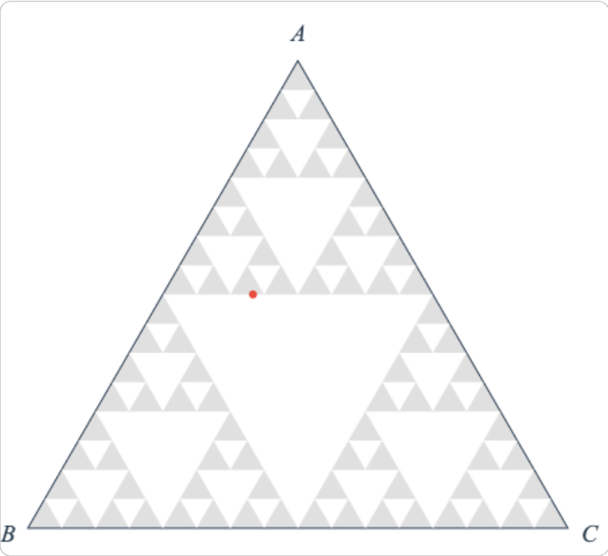
- The point with barycentric coordinates $w_A=\frac{1}{2}$, $w_B=\frac{1}{3}$, $w_C=\frac{1}{6}$ is in the Sierpinski gasket. This point is
$$P = \frac{1}{2}\left(\frac{1}{2},\frac{1}{2}\sqrt{3}\right) + \frac{1}{3}(0,0) + \frac{1}{6}(1,0) = \left(\frac{1}{4}+\frac{1}{6}, \frac{1}{4}\sqrt{3}\right) = \left(\frac{5}{12}, \frac{1}{4}\sqrt{3}\right).$$
The binary expansion of the three barycentric coordinates are
$$\begin{array}{r@{\;}c@{\;}l@{\;}c@{\;}l}
w_A = \frac{1}{2} &=& 0.1 &=& 0.10000000000000000000\dots \\
w_B = \frac{1}{3} &=& 0.\overline{01} &=& 0.01010101010101010101\dots \\
w_C = \frac{1}{6} &=& 0.0\overline{01} &=& 0.00101010101010101010\dots
\end{array}
$$
At every binary position, only one expansion has a digit 1 in that position, so $a_k+b_k+c_k = 1 \text{ for all } k \ge 1$. This point is on the boundary of the first middle triangle removed during the construction of the gasket because $w_A = \frac{1}{2}$ is a dyadic rational.
[Show plotted point]
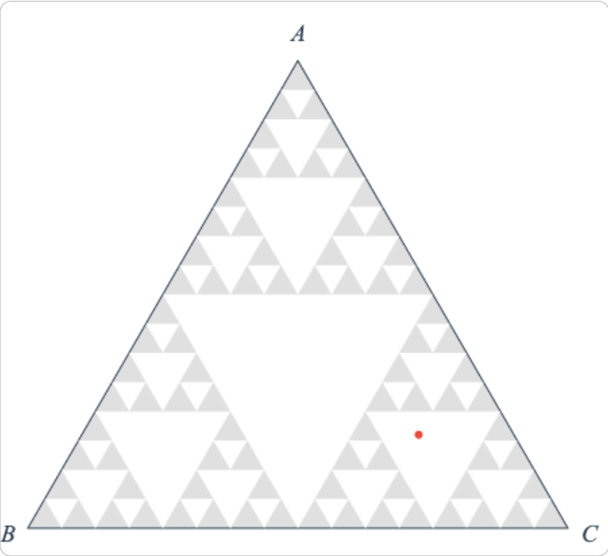
- The point with barycentric coordinates $w_A=\frac{1}{5}$, $w_B=\frac{3}{17}$, $w_C=\frac{53}{85}$ is not in the Sierpinski gasket. This point is
$$P = \frac{1}{5}\left(\frac{1}{2},\frac{1}{2}\sqrt{3}\right) + \frac{3}{17}(0,0) + \frac{53}{85}(1,0) = \left(\frac{123}{170}, \frac{1}{10}\sqrt{3}\right).$$
The binary expansion of the three barycentric coordinates are
$$\begin{array}{r@{\;}c@{\;}l@{\;}c@{\;}l}
w_A = \frac{1}{5} &=& 0.\overline{0011} &=& 0.00\,\textcolor{red}{1}\,1001100110\dots \\
w_B = \frac{3}{17} &=& 0.\overline{00101101} &=& 0.00\,\textcolor{red}{1}\,0110100101\dots \\
w_C = \frac{53}{85} &=& 0.\overline{10011111} &=& 0.10\,\textcolor{red}{0}\,1111110011\dots
\end{array}
$$
Since $a_3+b_3+c_3 = 2$, this point was removed during the second iteration in the construction of the Sierpinski gasket.
[Show plotted point]
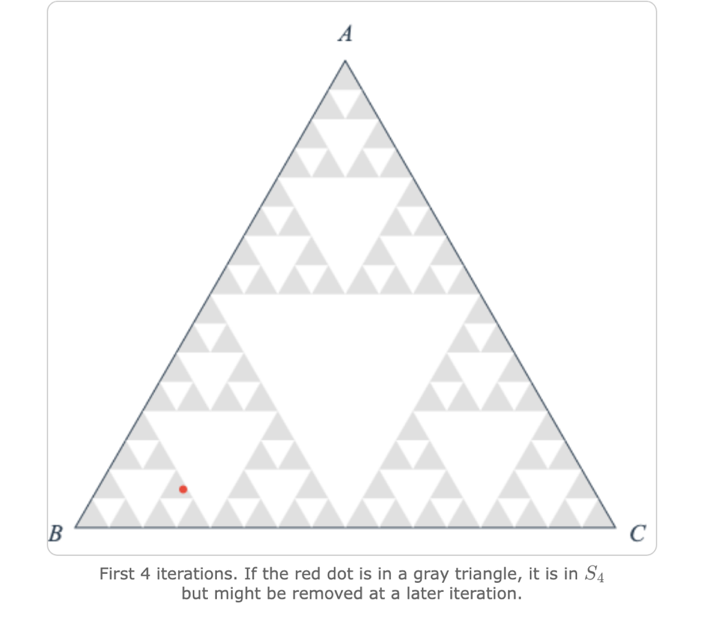
- The point $(\frac{1}{5},\frac{1}{14})$ is not in the Sierpinski gasket. The barycentric coordinates for this point are
$$\begin{aligned}
w_A &\approx 0.08247861 \\
w_B &\approx 0.75876070 \\
w_C &\approx 0.15876070
\end{aligned}
$$
with the beginning binary expansions being
$$
\begin{aligned}
w_A &= 0.0001010100\,\textcolor{red}{0}\,011101\dots \\
w_B &= 0.1100001000\,\textcolor{red}{1}\,111110\dots \\
w_C &= 0.0010100010\,\textcolor{red}{1}\,100100\dots
\end{aligned}
$$
Since $a_{11}+b_{11}+c_{11}= 2$, this point was removed during the tenth iteration in the construction of the Sierpinski gasket.
[Show plotted point]
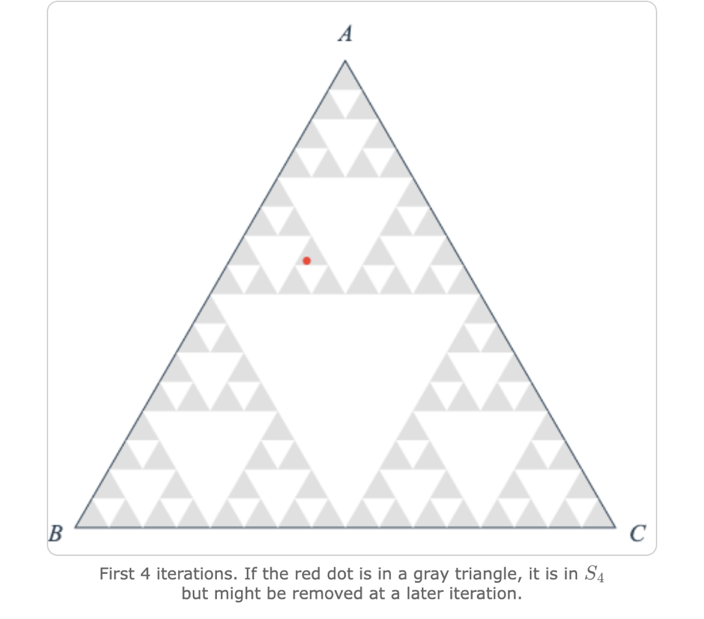
- The point $(\frac{3}{7},\frac{2}{7}\sqrt{3})$ is the Sierpinski gasket. The barycentric coordinates for this point are
$$\begin{aligned}
w_A = \frac{4}{7} = 0.\overline{100} = 0.10010010010010010010\cdots\\
w_B = \frac{2}{7} = 0.\overline{010} = 0.01001001001001001001\cdots\\
w_C = \frac{1}{7} = 0.\overline{001} = 0.00100100100100100100\cdots
\end{aligned}
$$
At every binary position, only one expansion has a digit 1 in that position, so $a_k+b_k+c_k = 1 \text{ for all } k \ge 1$. This point is in the Sierpinski gasket, but it is not a point on any of the edges of the "middle" triangles removed during the construction of the gasket because none of the barycentric coordinates is a dyadic rational.
[Show plotted point]
Click the "You Try It" button to access a Sierpinski Gasket calculator that can determine if a point, given in Euclidean coordinates or barycentric coordinates, is in the unit square is in the Sierpinski gasket.