Barycentric Proof for Sierpinski Gasket
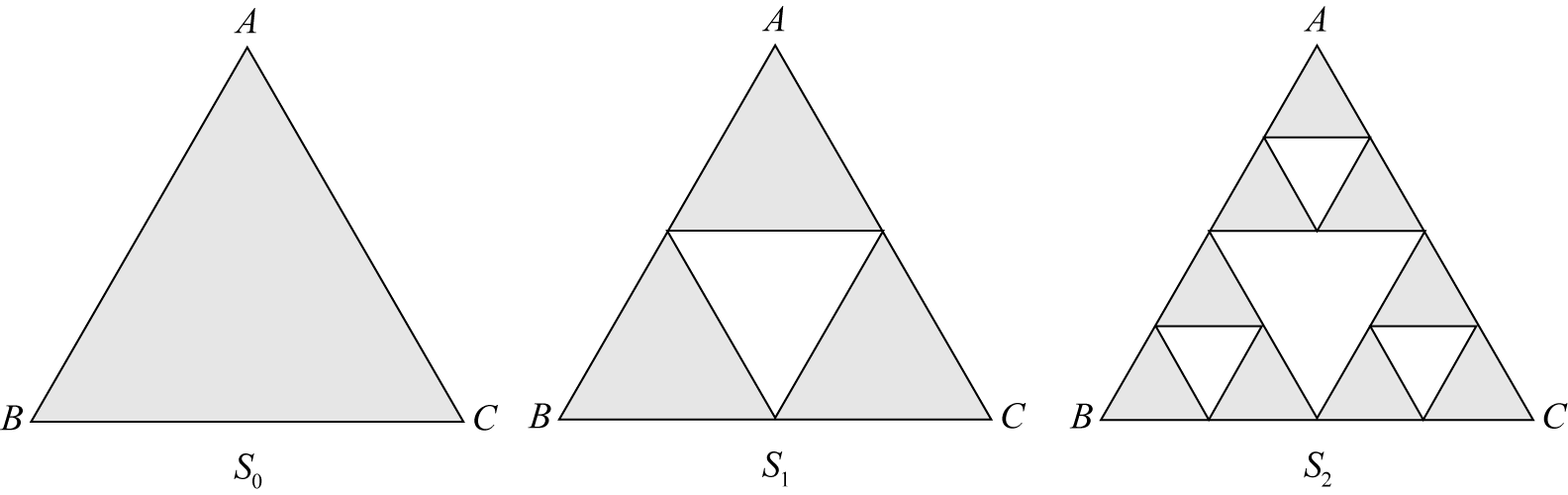
In a triangle $ABC$, any point $P$ can be defined by its barycentric coordinates $(w_A, w_B, w_C)$. These coordinates represent the "weights" assigned to each vertex such that \begin{equation} P = w_A A + w_B B + w_C C \end{equation} subject to the constraint $w_A + w_B + w_C = 1$.
Claim: The set $S_n$ in the $n$th iteration of the construction of the Sierpinski gasket is the set of all points whose barycentric coordinates have binary expansions that satisfy $$S_n = \left\{ (w_A,w_B,w_C) : a_k+b_k+c_k = 1 \text{ for all } k \le n+1 \right\}$$
We will show this by induction. Because $w_A+w_B+w_C = 1$, at least one of the barycentric coordinates of a point in $S_0$ must be greater than or equal to 1/2 and thus have a binary expansion that starts with $0.1$. But there cannot be two such coordinates or else the sum would exceed 1. The only exceptions are the midpoint of the sides of the triangle, which have barycentric coordinates using 1/2, 1/2, and 0. But one of those 1/2 coordinates can be written in binary as $0.0\overline{1}$, and then it will still be the case that there is only one binary bit 1 in the first position among the three coordinates. Thus $$S_0 = \left\{ (w_A,w_B,w_C) : a_1+b_1+c_1 = 1 \right\}$$ and the claim is true for $n=0$.
Now consider the interior of the middle triangle $M_1$ that is removed during the first iteration in the construction of the Sierpinski gasket.
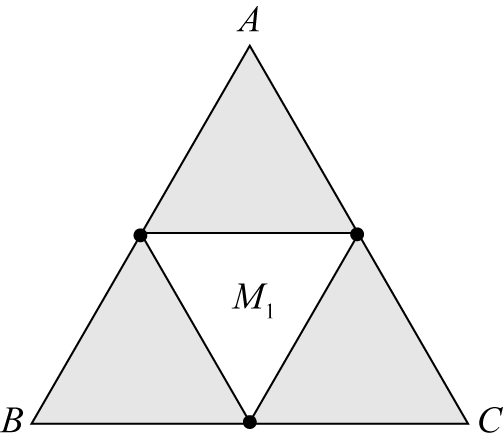
All the points in $M_1$ have barycentric coordinates $(w_A, w_B, w_C)$ that are less than 1/2 [Barycentric Details]. Therefore, in the binary expansions of these coordinates, we have $a_1 = b_1 = c_1 = 0$. But since $w_A + w_B + w_C$ must equal 1, there must be a carry from the second bit position to the first bit position when adding the binary digits of $(w_A, w_B, w_C)$. The only way that can happen is if there are at least two 1's among the binary bits in position 2. If only w_C had a 1 in the second position, for example, then we would have $w_A \lt 1/4$, $w_B \lt 1/4$, and $w_C \lt 1/2$. But then $w_A + w_B + w_C \lt 1$. So $$M_1 = \left\{ (w_A,w_B,w_C) : a_2+b_2+c_2 \ge 2 \right\}.$$
So if a point in $S_0$ has barycentric coordinates for which $a_2+b_2+c_2 = 1$, then it cannot be in $M_1$ and thus must be in $S_1$. Therefore $$S_1 = \left\{ (w_A,w_B,w_C) : a_i+b_i+c_i = 1 \text{ for } i = 1,2 \right\}$$ and the claim is true for $n=1$.
Let $M_2$ be one of the middle triangles removed during the second iteration. Here we will take the triangle closest to vertex $C$.
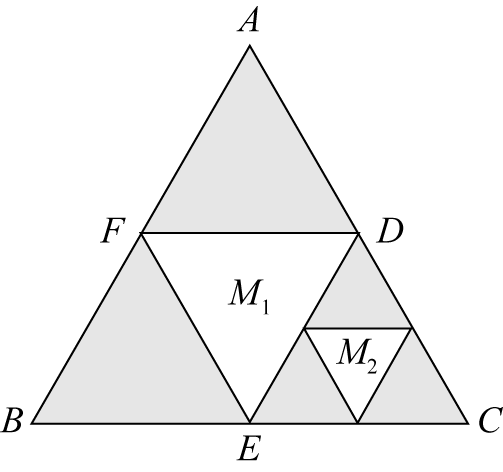
Let $D$, $E$, and $F$ be the midpoints of the side of $S_0$, where \[ D=\tfrac12(A+C),\quad E=\tfrac12(B+C),\quad F=\tfrac12(A+B). \] We can translate $\triangle DEC$ to move point $E$ to point $B$ using the affine map
$$T(x) = x + B-E$$ and then scale $\triangle DEC$ by 2 while keeping point $B $ fixed using the affine map
$$f(x)=2(x-B) + B =2x-B.$$Combining these two operations gives the affine map
$$W(x) = f(T(x)) = 2(x + B-E) - B) = 2x - 2E + B = 2x - C$$Notice that
- \(W(D)=2D - C = A+C-C = A\)
- \(W(E))=2E-C = B + C -C=B\)
- \(W(C)=2C- C = C \)
The translation and scaling therefore maps $\triangle DEC$ onto $\triangle ABC$, and also maps $M_2$ onto $M_1$.
Suppose $P$ is a point in $M_2$ with barycentric coordinates $(a,b,c)$ with respect to $\triangle ABC$, so $P = aA + bB + cC$. Let $P' = f(P)$.
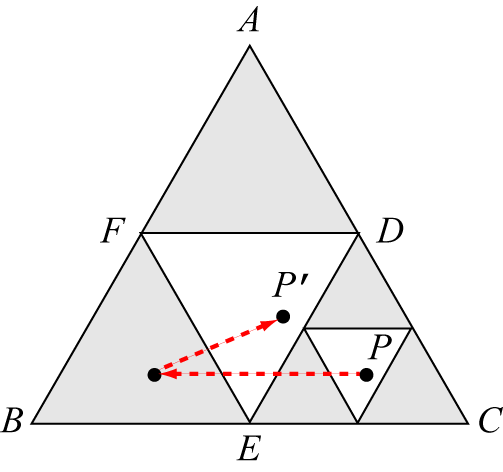
We can apply the affine map $W$ to the point $P$ to get $$P' = W(P) = 2aA+2bB+2cC - C = 2aA + 2bB + (2c-1)C.$$
This means that $(2a,2b,2c-1)$ are the barycentric coordinates of $P'$ with respect to $\triangle ABC$. Note that $2a+2b+2c-1 = 2-1 = 1$ as required for barycentric coordinates. Because of how $\triangle DEC$ is positioned with respect to the midlines $FD$, $FE$, and $DE$, we know that $a \lt \frac12$, $b \lt \frac12$, and $c \gt \frac12$ [Barycentric Details]. Therefore $2c-1 \gt 0$. We can use these observations to compute the binary expansion of the barycentric coordinates of $P'$ in terms of the binary expansion of the barycentric coordinates of $P$.
$$ \begin{array}{lclcl} \begin{aligned} a &= 0.0a_2a_3a_4\dots \\ b &= 0.0b_2b_3b_4\dots \\ c &= 0.1c_2c_3c_4\dots \end{aligned} & \Rightarrow & \begin{aligned} 2a &= 0.a_2a_3a_4\dots \\ 2b &= 0.b_2b_3b_4\dots \\ 2c &= 1.c_2c_3c_4\dots \end{aligned} \Rightarrow & \begin{aligned} 2a &= 0.a_2a_3a_4\dots \\ 2b &= 0.b_2b_3b_4\dots \\ 2c-1 &= 0.c_2c_3c_4\dots \end{aligned} \end{array} $$The net result is that the binary digits of the barycentric coordinates of $P'$ are the same as those of $P$ after dropping the first digit in each expansion for $P$. Since $P'$ is in $M_1$, we must have $a_2 = b_2 = c_2 = 0$ and $a_3+b_3+c_3 \gt 1$, the same conditions as that for the points in $M_1$, just shifted over one position.
The same result can be shown to hold in a similar way for points in the middle subtriangles of $\triangle FBE$ and $\triangle AFD$. So if a point in $S_1$ has barycentric coordinates for which $a_3+b_3+c_3 = 1$, then it cannot be in one of these middle triangles and thus must be in $S_2$. Therefore $$S_2 = \left\{ (w_A,w_B,w_C) : a_i+b_i+c_i = 1 \text{ for } i = 1,2,3 \right\}$$ and the claim is true for $n=2$.
We now generalize the method just used for $S_2$ in the induction step. Suppose the claim is true for the integer $n$. Let $\triangle UVW$ be one of the standard dyadic subtriangles contained in $S_n$, so $\triangle UVW$ is a $2^{-n}$-scaled subtriangle of $S_0$. The barycentric coordinates of the lower left vertex $V$ can be expressed as the dyadic rationals $\left(\frac{\alpha}{2^n}, \frac{\beta}{2^n}, \frac{\gamma}{2^n}\right)$ with respect to $\triangle ABC$, where $\alpha,\beta,\gamma$ are integers in $\{0,1,\ldots,2^n\}$, and $\alpha + \beta + \gamma = 2^n$.
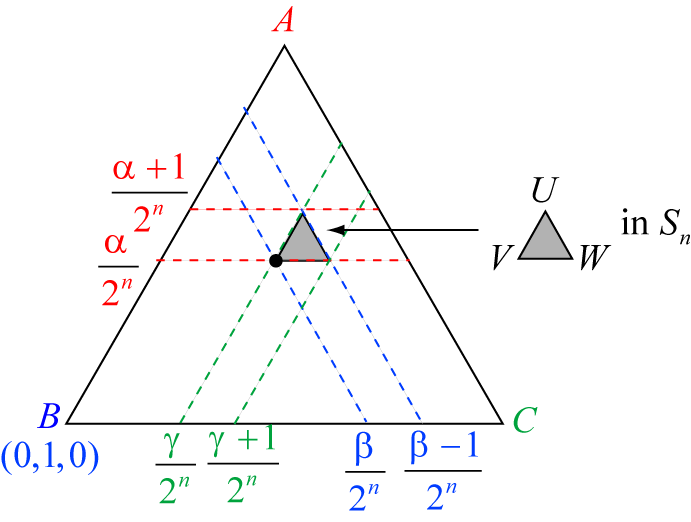
Then $\triangle UVW$ lies between the barycentric subdivision lines $$\begin{aligned} w_A &= \frac{\alpha}{2^n} \text{ and } w_A = \frac{\alpha+1}{2^n} \\ w_B &= \frac{\beta}{2^n} \text{ and } w_B = \frac{\beta-1}{2^n} \\ w_C &= \frac{\gamma}{2^n} \text{ and } w_C = \frac{\gamma+1}{2^n} \\ \end{aligned} $$ The barycentric coordinate with respect to vertex $B$ decreases as a point moves away from $B$, hence the subtraction in one of the lines for $w_B$. The affine map that translates $\triangle UVW$ so that vertex $V$ moves to vertex $B$ is given by $$T(a,b,c) = (a,b,c) + (0,1,0) - \left(\frac{\alpha}{2^n}, \frac{\beta}{2^n}, \frac{\gamma}{2^n}\right) = \left(a - \frac{\alpha}{2^n}, b+1-\frac{\beta}{2^n}, c - \frac{\gamma}{2^n}\right).$$ If we then follow this translation with a scaling by $2^n$ that keeps vertex $B$ fixed, we get the affine map $$\begin{aligned} f(a,b,c) &= 2^n\left(\left(a - \frac{\alpha}{2^n}, b+1-\frac{\beta}{2^n}, c - \frac{\gamma}{2^n}\right)-(0,1,0)\right) + (0,1,0) \\ \\ &= \left(2^na - \alpha, 2^nb-(\beta-1), 2^nc -\gamma\right). \end{aligned} $$ The image of $\triangle UVW$ under this map is $\triangle ABC$.
Let $P$ be a point in the interior of $\triangle UVW$ with barycentric coordinates $(a,b,c)$ with respect to \(ABC\), where $$\begin{aligned} a &= 0.a_1a_2a_3\ldots,\\ b &= 0.b_1b_2b_3\ldots,\\ c &= 0.c_1c_2c_3\ldots, \end{aligned} $$ written in binary, with \(a+b+c=1\). The first \(n\) binary digits of each barycentric coordinate are fixed throughout the triangle so we can write $$ \begin{aligned} a &= \frac{\alpha}{2^n} + \frac{\tilde{a}}{2^n},\\ b &= \frac{\beta-1}{2^n} + \frac{\tilde{b}}{2^n},\\ c &= \frac{\gamma}{2^n} + \frac{\tilde{c}}{2^n}, \end{aligned} $$ where $\alpha,\beta,\gamma$ are integers in $\{0,1,\ldots,2^n\}$ and $$\begin{array}{lcl} \dfrac{\alpha}{2^n} &= 0.a_1a_2a_3\ldots a_n & \quad\quad & \tilde a &= 0.a_{n+1}a_{n+2}a_{n+3}\dots \\ \dfrac{\beta-1}{2^n} &= 0.b_1b_2b_3\ldots b_n & \quad\quad & \tilde b &= 0.b_{n+1}b_{n+2}b_{n+3}\dots \\ \dfrac{\gamma}{2^n} &= 0.c_1c_2c_3\ldots c_n & \quad\quad & \tilde c &= 0.c_{n+1}c_{n+2}c_{n+3}\dots \end{array} $$
Let $P' = f(P) = f(a,b,c)$. The barycentric coordinates of the image point $P'$ with respect to $\triangle ABC$ after the translation and scaling are $$\left(2^na - \alpha, 2^nb-(\beta-1), 2^nc -\gamma\right) = \left(\tilde a, \tilde b, \tilde c \right).$$ This shows that for standard dyadic subtriangles in $S_n$, the combined translation–scaling map acts on barycentric coordinates by removing the first $n$ binary digits of each coordinate.
Let $M$ be the middle triangle that is removed from $\triangle UVW$ during the iteration that produces $S_{n+1}$. Then the translation-scaling map $f$ given above maps $M$ onto $M_1$. If the point $P$ is in $M$, then $P' = f(P)$ is in $M_1$. The barycentric coordinates of $P'$ have the binary expansion $$\begin{aligned} \tilde a &= 0.a_{n+1}a_{n+2}a_{n+3}\dots \\ \tilde b &= 0.b_{n+1}b_{n+2}b_{n+3}\dots \\ \tilde c &= 0.c_{n+1}c_{n+2}c_{n+3}\dots \\ \end{aligned} $$ and therefore since $P'$ is in $M_1$, we must have $a_{n+1} = b_{n+1} = c_{n+1} = 0$ and $a_{n+2} + b_{n+2} + c_{n+2} \ge 2$.
Now this result holds for all the middle triangles. So if a point in $S_{n+1}$ has barycentric coordinates for which $a_{n+2}+b_{n+2}+c_{n+2} = 1$, then it cannot be in one of these middle triangles removed from $S_n$ and thus must be in $S_{n+1}$. Therefore $$S_{n+1} = \left\{ (w_A,w_B,w_C) : a_i+b_i+c_i = 1 \text{ for } i \le n+2 \right\}.$$
By induction, the claim is true for all sets $S_n$, and since the Sierpinski gasket is the intersection of these sets for $n \ge 0$, we have $$S = \left\{ (w_A,w_B,w_C) : a_i+b_i+c_i = 1 \text{ for all } i \ge 1 \right\}.$$
Special Note: Nowhere in the argument above did we ever make use of the Euclidean coordinates of the vertices of $\triangle ABC$. So the barycentric characterization of the Sierpinski gasket would still apply to any fractal generated by starting with an arbitrary triangle in the plane and recursively removing the middle subtriangles at each iteration. What would be dependent on the Euclidean coordinates of the triangle would be the actual values of the barycentric coordinates, but not the requirement that the binary expansions satisfy $a_i+b_i+c_i = 1$ at every position.
Here is a particular application of this special note. The Sierpinski right triangle is formed by starting with the right triangle with vertices at (1,0), (0,1), and (0,0).
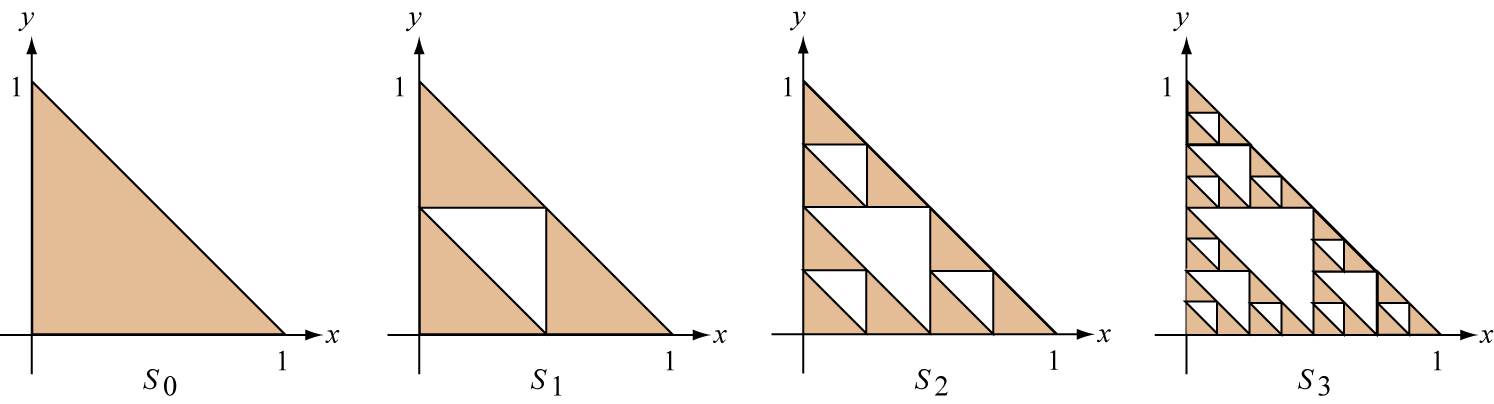 For any point $P = (x,y)$, we can write
$$P = x(1,0) + y(0,1) + (1-x-y)(0,0)$$
and so the barycentric coordinates of $P$ with respect to this right triangle are $(x,y,1-x-y)$. The point $P$ would be in the Sierpinski right triangle if, among the binary digits at each position of the binary expansion of $x$, $y$, and $1-x-y$, there is only one 1. Thus at each position in the binary expansions, at least one of the corresponding binary digits of $x$ and $y$ in that position would be 0 (it is possible that both binary digits could be 0.) For more details, see Binary Description of the Sierpinski Right Triangle.