
Symmetric Fractals
Description
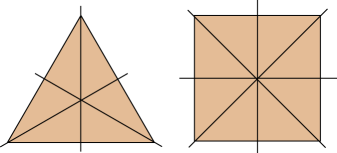
The group $Z_n$ consists of the rotational symmetries of a regular n-sided polygon. We can let the n elements of $Z_n$ be represented by counterclockwise rotations about the origin (which corresponds to the center of the polygon) through angles that are integer multiples of 360°/n. The group $D_n$ consists of all $2n$ symmetries of a regular $n$-sided polygon. These are the $n$ rotations in $Z_n$ and the reflections about $n$ lines through the origin and a vertex or midpoint of a side. The following figure shows the symmetry reflections for an equilateral triangle ($D_3$) and a square ($D_4$) which are representative of what happens with regular polygons with odd and even number of vertices, respectively.
An exception is $D_2$ since there is no regular polygon with 2 sides. The group $D_2$ is known as the Klein four-group with the four elements being the identity, a vertical reflection, a horizontal reflection, and a 180° rotation.
Let $H$ be a set of $k$ affine transformations in an iterated function system. Let $G$ be a cyclic symmetry group or dihedral group of n elements. We can form a new set of functions by composing each of the symmetries in $G$ with each of the functions in H to form the set $F = \{f_r : 1 \le r \le m=kn\}$ where each $f_r = g \circ h$ for some $g$ in $G$ and some $h$ in $H$. Since each affine contraction in $H$ consists of rotations, scaling, and translations, each $g \circ h$ is again an affine contraction. Therefore $F$ will be an iterated function system with a unique attractor $B$.
We know that the attractor $B$ satisfies \[B = f_1(B) \cup f_2(B) \cup f_3(B) \cup \cdots \cup f_m(B)\] If $g$ is one of the symmetries in the group $G$, then \[g(B) = g \circ f_1(B) \cup g \circ f_2(B) \cup g \circ f_3(B) \cup \cdots \cup g \circ f_m(B)\] Now \(g \circ f_r = g \circ g_i \circ h_j\) for some \(g_i\) in $G$ and some \(h_j\) in $H$. Since applying $g$ to each of the elements of $G$ will just permute the elements of $G$, the collection \(g \circ f_r\) will consist of the same set of functions as in $F$. This means that the union of sets that make up $g(B)$ is the same union that gives $B$, and therefore $g(B) = B$. Therefore the attractor $B$ shares all the symmetries of the group $G$. See an example with $D_4$.
Pixel Coloring
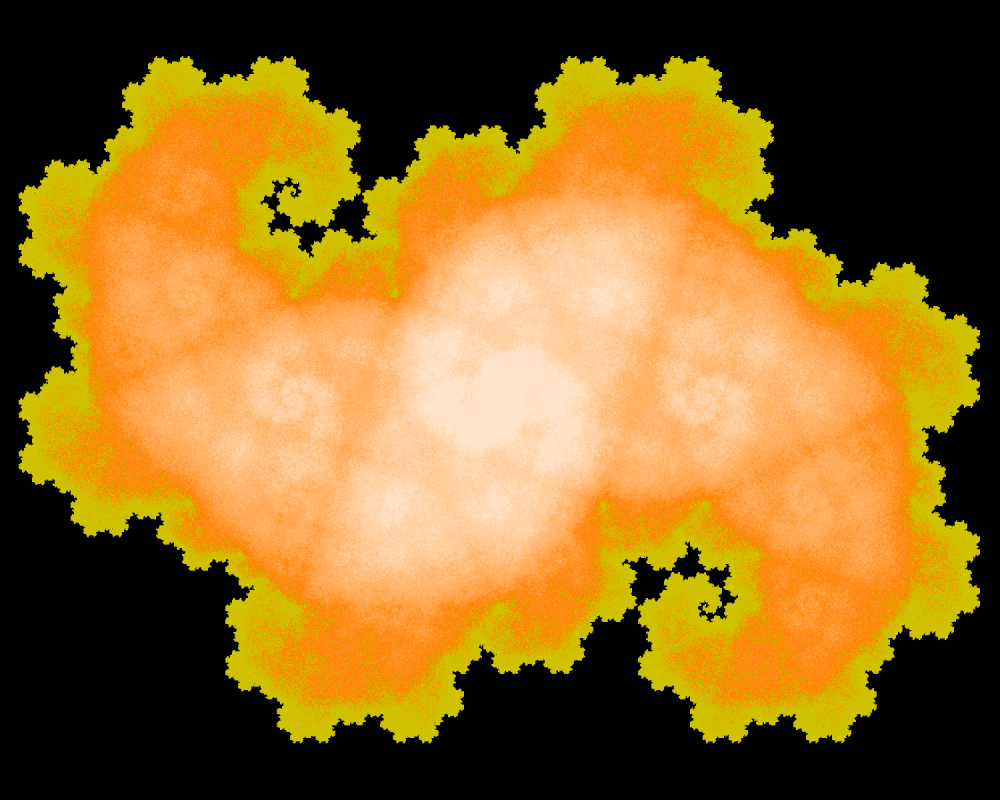
Of course, even the highest resolution computer screen has only finitely many pixels. A single pixel can represent infinitely many points in the attractor. One possible coloring scheme for the random algorithm, therefore, is to color a pixel based on how many points in the random sequence land in that pixel. The next figure shows an image of the symmetric fractal obtained by composing the two elements of $Z_2$ with the two functions in the Heighway dragon IFS, along with the color gradient that shows the colors assigned to pixels depending on the number of times they were drawn during the random algorithm. We colored golden yellow, shading to bright orange, if the pixel count was between 1 and 5. Between a pixel count of 5 and 150 there is a gradient range going from bright orange to a pale orange. Any pixel hit more than 150 times was plotted as if the count had been exactly 150.

Some experimentation is usually needed to find a good color gradient and corresponding pixel counts depending on the size of the final image, the resolution of the computer screen, the number of points to be plotted, and even the probabilities assigned to the functions in the IFS. But an appropriate choice helps to vividly illustrate the symmetry of the attractor.
Examples
| Image (Click for larger view) |
Iterated Function System |
Symmetry Group |
Detail Links |
|---|---|---|---|
 |
Heighway Dragon | $Z_2$ | $Z_2$ Heighway |
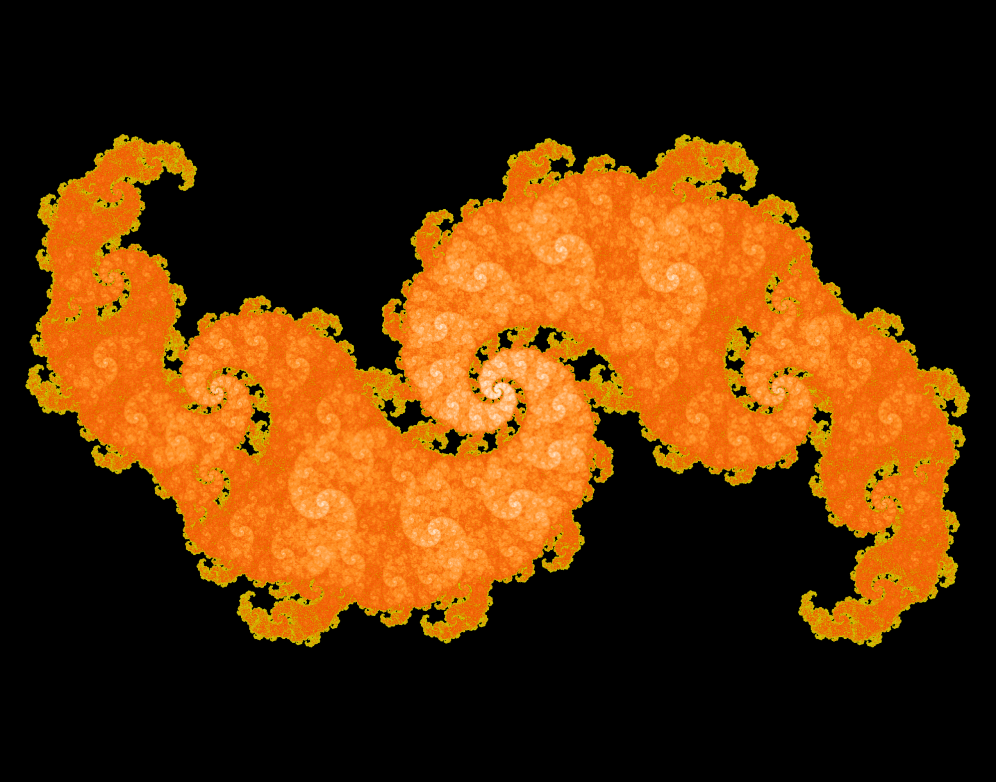 |
Golden Dragon | $Z_2$ | $Z_2$ Golden |
 |
Koch Curve | $D_2$ | |
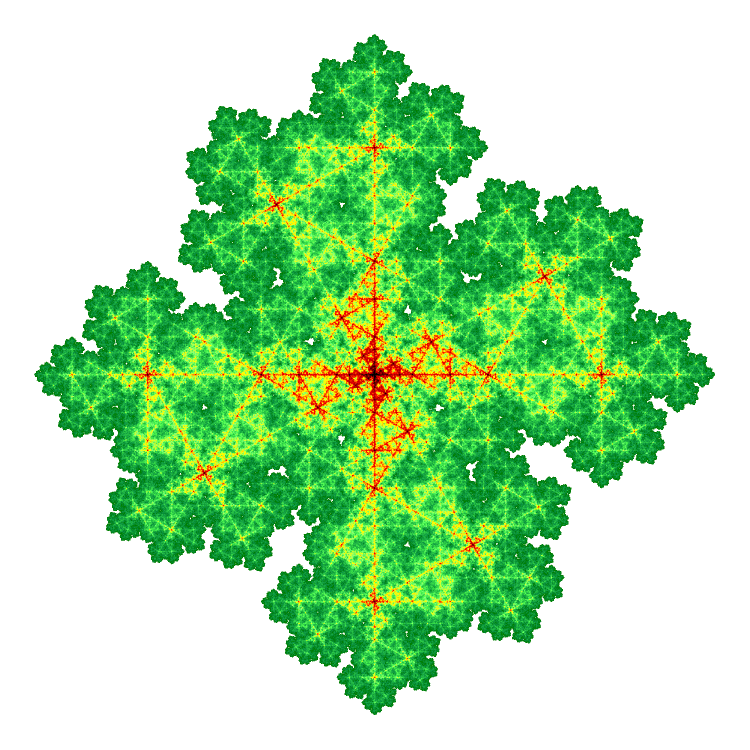 |
Koch Curve | $Z_4$ | |
 |
Koch Curve | $D_4$ | |
 |
Sierpinski Triangle | $Z_3$ | |
 |
45° Binary Tree | $Z_4$ | |
 |
45° Binary Tree | $Z_4$ | |
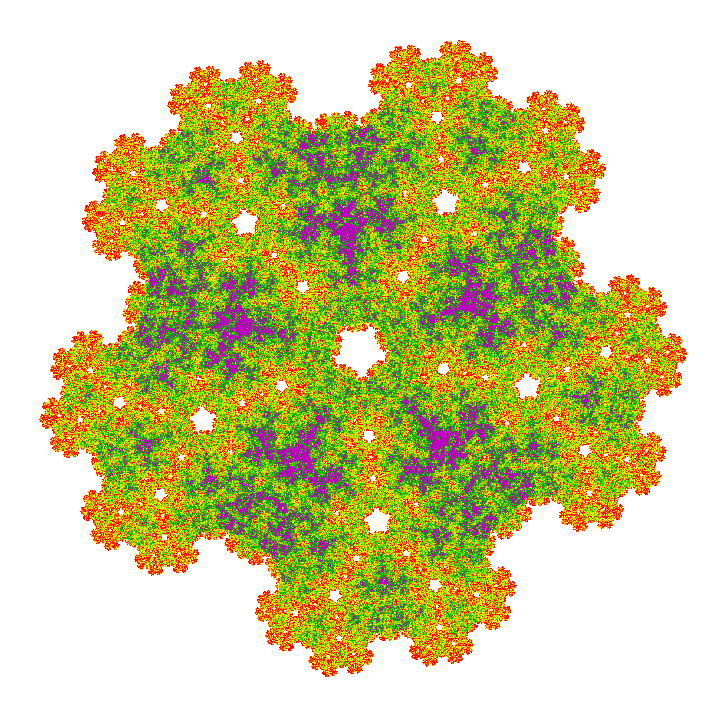 |
Single affine map scaling: 0.5 rotation: 180° translation: \(\left(\frac{1}{2},\frac{\sqrt{3}}{2}\right)\) |
$Z_5$ |