
Four Symmetric Sierpinski Relatives
There are 8 symmetric Sierpinski relatives. The four videos below illustrates the construction of those symmetric relatives using just rotations (transformations 1, 2, 3, and 4) where the lower left piece is not rotated (transformation 1).
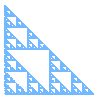
Relative 111
View extended version on YouTube
The IFS for relative 111 is
$$\begin{array}{l} {f_1}({\bf{x}}) = \left[ {\begin{array}{cc} {0.5} & 0 \\ 0 & {0.5} \\ \end{array}} \right]{\bf{x}} + \left[ {\begin{array}{c} 0 \\ {0.5} \\ \end{array}} \right] \\ {f_2}({\bf{x}}) = \left[ {\begin{array}{cc} {0.5} & 0 \\ 0 & {0.5} \\ \end{array}} \right]{\bf{x}} \\ {f_3}({\bf{x}}) = \left[ {\begin{array}{cc} {0.5} & 0 \\ 0 & {0.5} \\ \end{array}} \right]{\bf{x}} + \left[ {\begin{array}{c} {0.5} \\ 0 \\ \end{array}} \right] \\ \end{array}$$
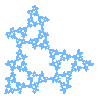
Relative 214
View extended version on YouTube
The IFS for relative 214 is
$$\begin{array}{l} {f_1}({\bf{x}}) = \left[ {\begin{array}{cc} {0} & -0.5 \\ 0.5 & {0} \\ \end{array}} \right]{\bf{x}} + \left[ {\begin{array}{c} 0.5 \\ {0.5} \\ \end{array}} \right] \\ {f_2}({\bf{x}}) = \left[ {\begin{array}{cc} {0.5} & 0 \\ 0 & {0.5} \\ \end{array}} \right]{\bf{x}} \\ {f_3}({\bf{x}}) = \left[ {\begin{array}{cc} {0} & 0.5 \\ -0.5 & {0} \\ \end{array}} \right]{\bf{x}} + \left[ {\begin{array}{c} {0.5} \\ 0.5 \\ \end{array}} \right] \\ \end{array}$$
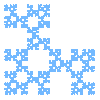
Relative 313
View extended version on YouTube
The IFS for relative 313 is
$$\begin{array}{l} {f_1}({\bf{x}}) = \left[ {\begin{array}{cc} {-0.5} & 0 \\ 0 & {-0.5} \\ \end{array}} \right]{\bf{x}} + \left[ {\begin{array}{c} 0.5 \\ {1} \\ \end{array}} \right] \\ {f_2}({\bf{x}}) = \left[ {\begin{array}{cc} {0.5} & 0 \\ 0 & {0.5} \\ \end{array}} \right]{\bf{x}} \\ {f_3}({\bf{x}}) = \left[ {\begin{array}{cc} {-0.5} & 0 \\ 0 & {-0.5} \\ \end{array}} \right]{\bf{x}} + \left[ {\begin{array}{c} {1} \\ 0.5 \\ \end{array}} \right] \\ \end{array}$$

Relative 412
View extended version on YouTube
The IFS for relative 412 is
$$\begin{array}{l} {f_1}({\bf{x}}) = \left[ {\begin{array}{cc} {0} & 0.5 \\ -0.5 & {0} \\ \end{array}} \right]{\bf{x}} + \left[ {\begin{array}{c} 0 \\ {1} \\ \end{array}} \right] \\ {f_2}({\bf{x}}) = \left[ {\begin{array}{cc} {0.5} & 0 \\ 0 & {0.5} \\ \end{array}} \right]{\bf{x}} \\ {f_3}({\bf{x}}) = \left[ {\begin{array}{cc} {0} & -0.5 \\ 0.5 & {0} \\ \end{array}} \right]{\bf{x}} + \left[ {\begin{array}{c} {1} \\ 0 \\ \end{array}} \right] \\ \end{array}$$