Counting the Number of Sierpinski Relative Fractals
Each Sierpinski relative can be described by a sequence of three digits corresponding to the transformations applied to each of the three squares in the pattern for that fractal. Because there are 8 possible transformations, there are 8x8x8 = 512 possible sequences.

Symmetric
Fractals
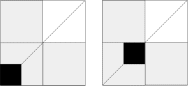
In the upper left square, the black square can be placed in any of the four corners. Once that choice is made, however, the location of the black square in the lower right square must be chosen in a way to maintain the symmetry with respect to the diagonal. There are therefore 2x4 = 8 possible choices for locating the black squares. These are shown below. Click on any of the images to toggle between the pattern and the corresponding fractal image.
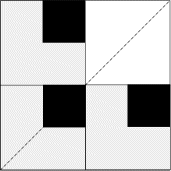
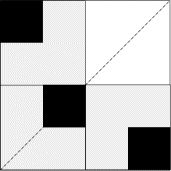
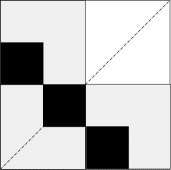
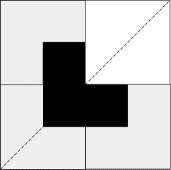
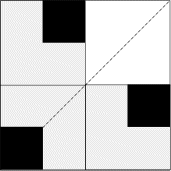
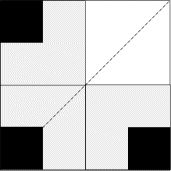
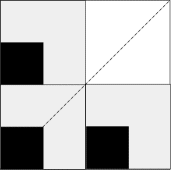
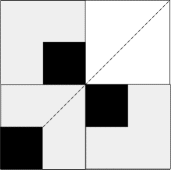
Now as long as another transformation that is applied to a square does not change the location of the black square, the attractor will not change. For each pattern above, there are two allowable transformations for each of the three squares that will preserve the symmetry. One of these transformations is the identity. The other is either 7 or 8, the reflections across the diagonals of a square.
Which reflection is allowed for a square depends on the location of the black subsquare in that square. For example, in the pattern
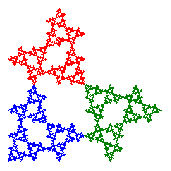
the possible transformations are {1,8} for the upper left square, {1,7} for the lower left square, and {1,8} for the lower right square. There are therefore 8 different 3-digit sequences that will leave the black squares in this pattern in the same location and thus produce the same fractal. These are shown below.

The same is true for each of the other 7 symmetric patterns. This accounts for 64 of the 512 possible 3-digit sequences.
Non-Symmetric
Fractals
To get a sense of why this works, first note that in reflecting the pattern across the diagonal, the upper left and lower right squares will trade places. This is why the order of the sequence is reversed. Second, if $F$ represents the iterated function system for the pattern $(a,b,c)$ and if $A$ is the attractor for that IFS, then $T_7(A)$ would represent the diagonal reflection of $A$, where $T_7$ is the transformation corresponding to the diagonal reflection. Since $F(A) = A$ and $T_7T_7$ is the identity transformation, we would have
$$ T_7FT_7(T_7(A)) = T_7F(A) = T_7(A).$$This shows that $T_7(A)$ is the attractor (fixed point) for the IFS given by $T_7FT_7$.
According to the dihedral group multiplication table, we have
$7 \circ 1 \circ 7 = 1$
$7 \circ 2 \circ 7 = 4$
$7 \circ 3 \circ 7 = 3$
$7 \circ 4 \circ 7 = 2$
$7 \circ 5 \circ 7 = 6$
$7 \circ 6 \circ 7 = 5$
$7 \circ 7 \circ 7 = 7$
$7 \circ 8 \circ 7 = 8$
So for example, if we start with the sequence 627, its symmetric counterpart would be 745. These patterns and corresponding fractals are shown below.
627
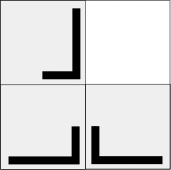
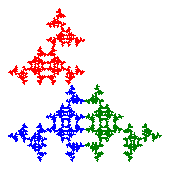
745
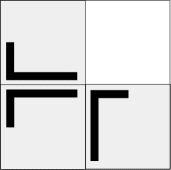
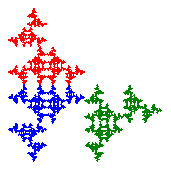
Since the non-symmetric fractals can be grouped into pairs, there are essentially 224 different non-symmetric Sierpinski relative fractals. Below are examples of 8 such fractals, done in counted cross-stitch.
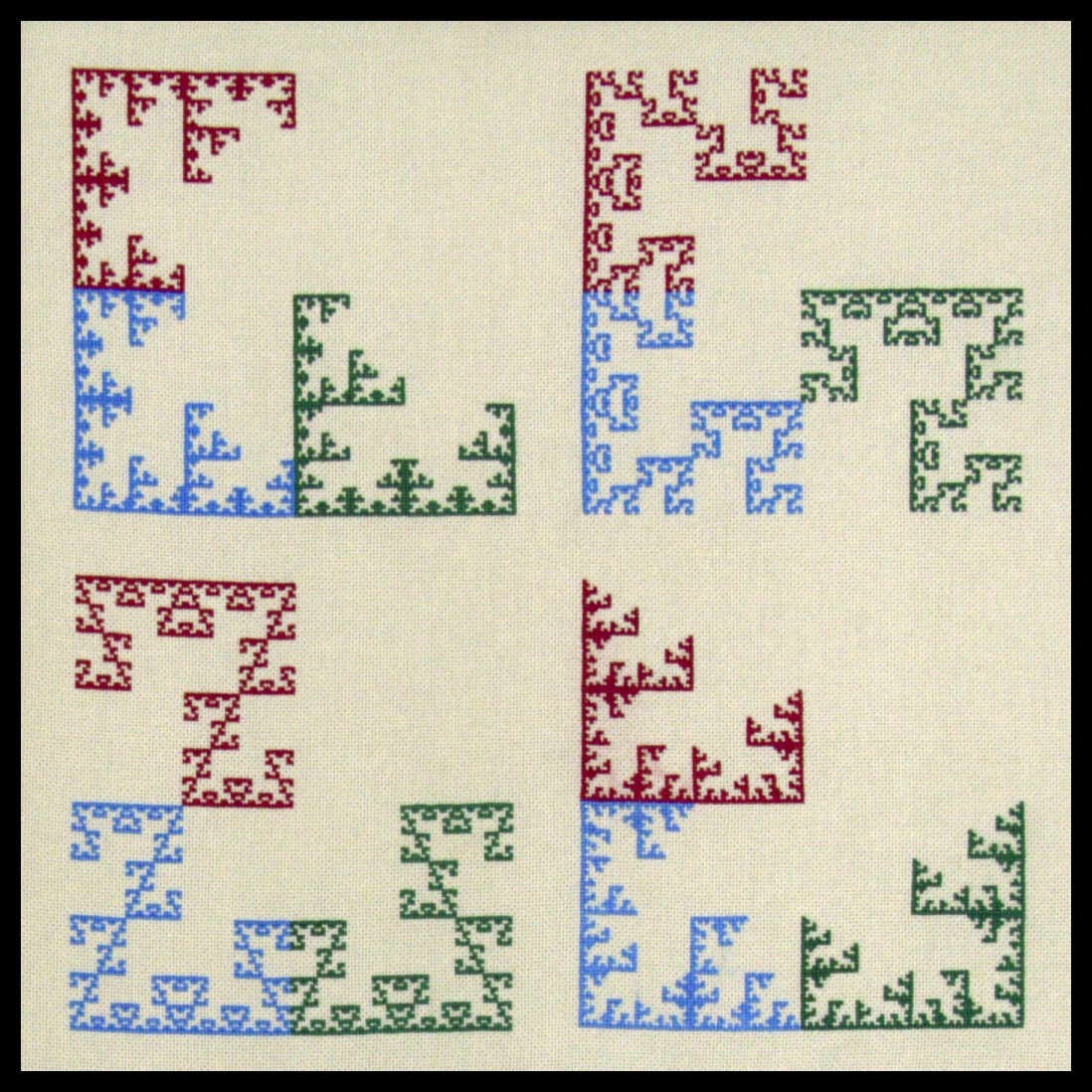
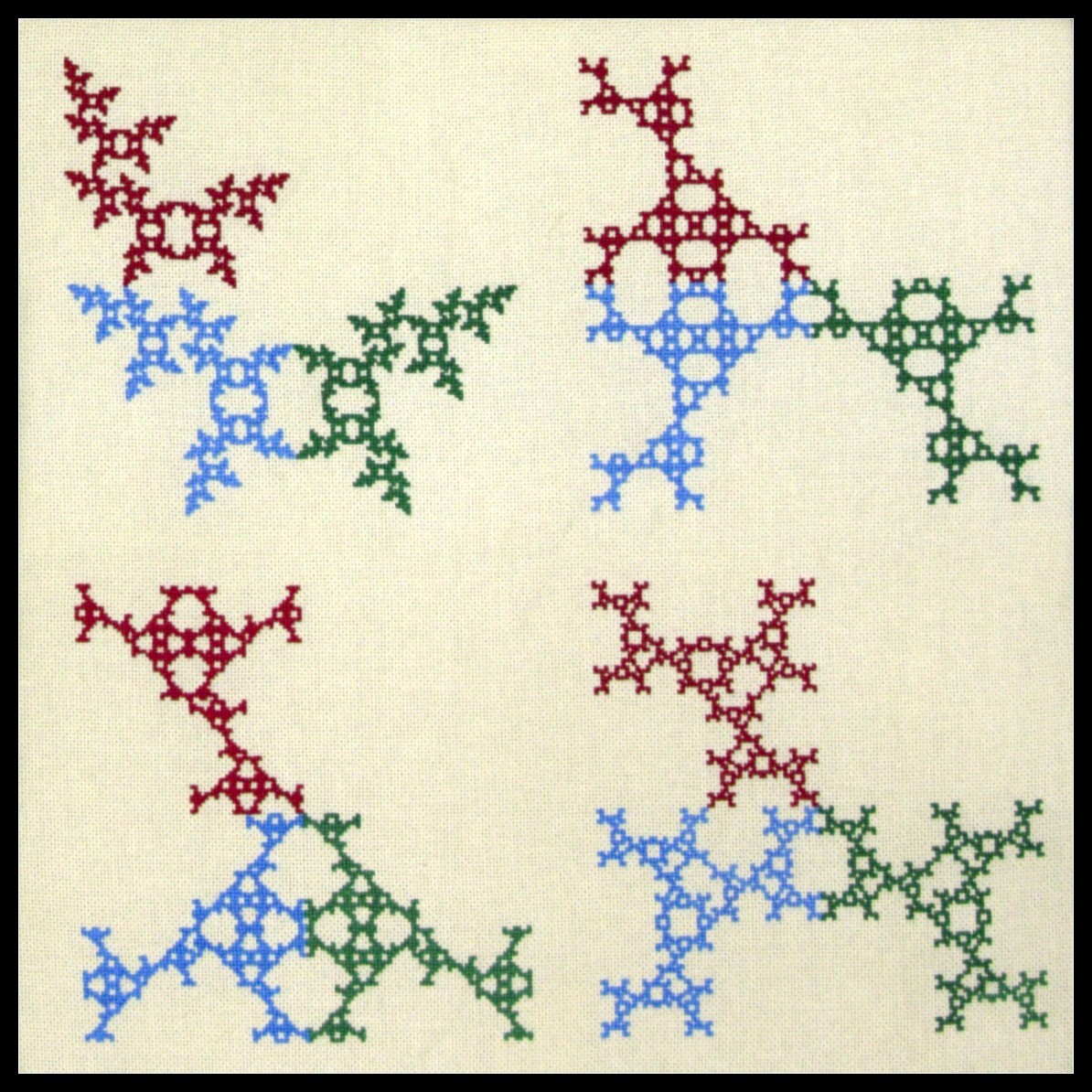
Larry Riddle, 2011
Sierpinski Theme and Variations
(7 iterations on 25 count per inch fabric, 13.5" x 13.5")
Click on each picture for a larger view.
See a Gallery of all 232 fractals.
References
- Heinz-Otto Peitgen, Hartmut Jurgens, and Dietmar Saupe. Chaos and Fractals: New Frontiers of Science, 2nd Edition, Springer-Verlag, 2004 , pp230-237 (pp244-251 in the 1992 first edition).