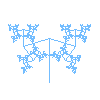
Golden 108° Symmetric Binary Tree
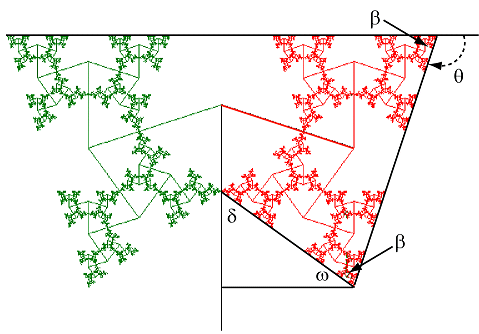
The red subtree whose trunk starts at the top of the main tree's trunk is a scaled version of the main tree. It has been rotated by $\theta$ and therefore the top edge of the main tree is also rotated by $\theta$ to become the top edge of the red subtree (and also scaled by $r$). Therefore angle $\beta = 180^\circ - \theta$.
We also have $\omega + \beta = \theta$ and so $\omega = \theta - \beta = 2\theta - 180^\circ$. Hence $\delta = 90^\circ - \omega = 270^\circ - 2\theta$. For the golden 108° tree, therefore, $\delta$ = 54° and $\beta$ = 72°.
(Note: These calculations for the angles work for any self-contacting symmetric binary tree with 90° ≤ $\theta$ ≤ 135°.)
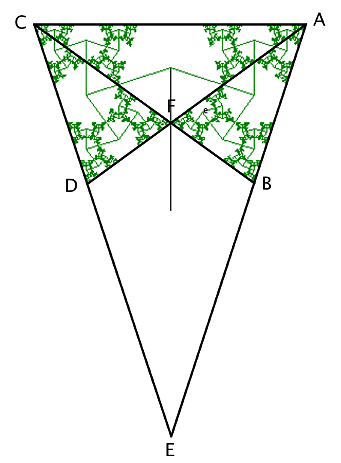
If the two sides of the golden 108° tree are extended until they meet, the result will be a triangle with angles 72°-72°-36°, that is, the golden triangle $ACE$ in the figure to the left. But the subtree whose trunk is the first R branch is self-similar to the original tree, and thus it lies inside the golden triangle $ACB$. Moreover, the subtree whose trunk is the last branch of the path RR is also self-similar to the original tree, and thus it lies inside the golden triangle $ABF$. Since the edge BF of the tree makes an angle of 54° with the trunk of the tree, angle BFD is 108°, and therefore segments AF and FD are collinear.
By symmetry, triangles $ACD$ and $CFD$ are also golden triangles, and segment BC passes through point F.