
Pythagorean Tree Spirals
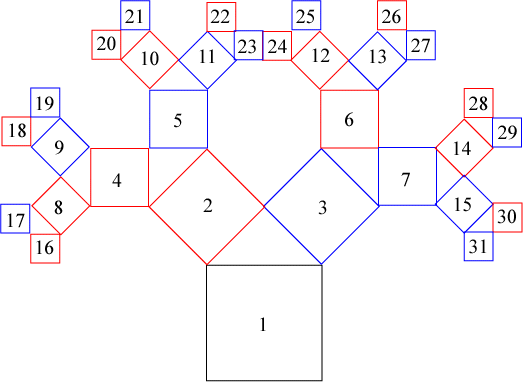
The Pythagorean tree is full of spirals. Only it is often difficult to see them because during the iterative construction the squares begin to overlap after the fourth iteration. Suppose you number the squares as in the figure below. The initial square is labeled with index 1. If a square has label $n$ and a right isosceles triangle is placed on top on which two new squares are constructed, then the new square on the left will have index $2n$ and the new square on the right will have index $2n+1$. Notice in the figure that the red squares have an even index and the blue squares have an odd index.
Now take all the squares that are powers of 2. Starting from the initial squares, the squares that are powers of 2 will form a spiral towards the left. The dotted lines emanating from the corners of the squares will all intersect at a common point. Each of those dotted lines are successively rotated counterclockwise by 45°. This is indicative of the logarithmic spiral that is illustrated in the figure below.
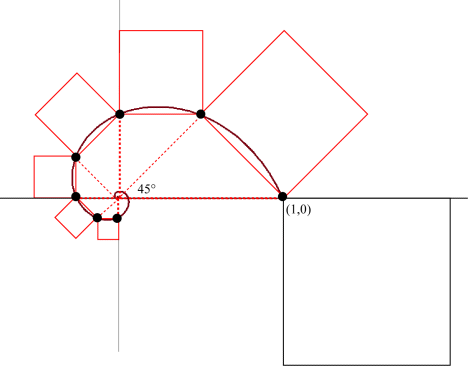
In this 45° case, the upper left corner of the initial square will be located at the point (1,0). A logarithmic spiral has the polar equation \(r = ae^{b \theta}\). Here we want to spiral inward, so $b$ should be negative. We have $r$ = 1 when $\theta$ = 0 and $r = \sqrt(2)/2$ when $\theta = \pi/4$. This means that $a$ = 1 and that
\[\frac{{\sqrt 2 }}{2} = {e^{b \cdot \pi /4}} \Rightarrow \ln \left( {\frac{{\sqrt 2 }}{2}} \right) = b \cdot \frac{\pi }{4} \Rightarrow b = \frac{4}{\pi }\ln \left( {\frac{{\sqrt 2 }}{2}} \right) \approx - 0.44127\]The corners of the red squares will continue to lie along this logarithmic spiral and the squares will spiral into the origin.
There is nothing special about the squares that are a power of 2 except that they all move to the left during the construction of the tree. If you start with any square in the Pythagorean tree construction, say with index $n$, then the squares with indices $n\cdot2^k$ will spiral to the left of square $n$ and the squares with indices $n\cdot 2^k+(2^k-1)$ will spiral to the right as $k$ increases toward infinity. Thus the Pythagorean tree is full of an infinite number of spirals.
This is easier to see with a smaller angle in the construction of the Pythagorean tree, such as using 20° for one of the angles.
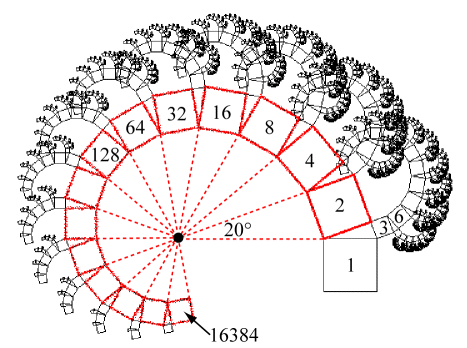
This time the dotted lines are rotated counterclockwise through 20°, and again they meet at a common point which we can take as the origin. The side of square 2 has length $\cos(20°)$. The hypotenuse of that triangle has length $\cos(20°)/\cos(70°)$. The third side has length $\cos(20°)\tan(70°)$. If we again take the common point as the origin, the logarithmic spiral \(r = ae^{b \theta}\) would have ${a = \cos(20°)/\cos(70°)} \approx 2.74748$ and
\[\begin{align} \cos \left( {20^\circ } \right)\tan \left( {70^\circ } \right) = \frac{{\cos (20^\circ )}}{{\cos (70^\circ )}}{e^{b \cdot \pi /9}} &\Rightarrow \ln \left( {\sin (70^\circ )} \right) = b \cdot \frac{\pi }{9} \\ &\Rightarrow b = \frac{9}{\pi }\ln \left( {\sin (70^\circ )} \right) \approx - 0.17820 \\ \end{align}\]Here is a picture of that logarithmic spiral with the squares after 6 iterations.
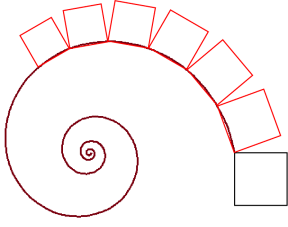
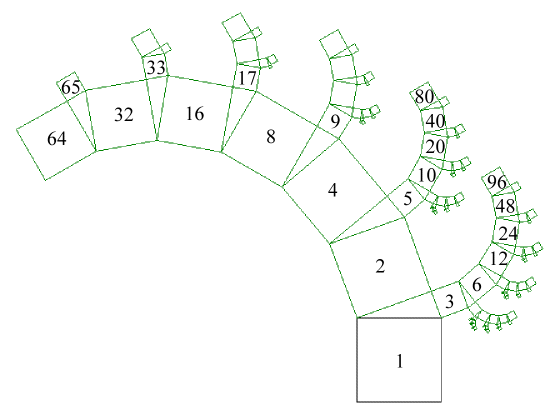
Now that's not the only spiral in this Pythagorean tree. Below is a picture of the rest of the tree after 6 iterations. You can see the start of left spirals starting at squares 3, 5, 9, 17, 33, and 65. But off the square 3 spiral is the beginning of other smaller spirals starting at squares 7, 13, 25, 49 and 97. And each of those have there own spirals, and so on and so on. This is all a consequence of the self-similarity of the fractal. See the animation for a demonstration of the growth of the spirals through 50 iterations.
Animation