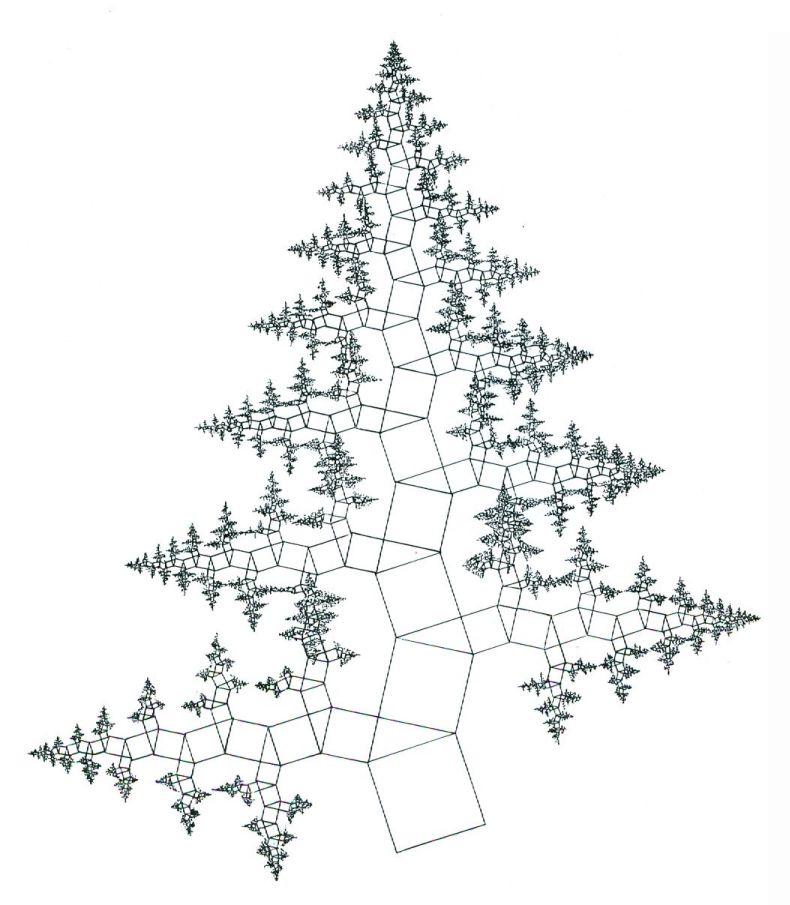

Bosman's Treatise on the Pythagorean Tree
The Pythagorean tree was apparently first drawn by Albert E. Bosman (1891-1961) around 1942. Bosman was a Dutch electrical engineering and mathematics teacher. In 1957 he published the book Het wondere onderzoekingsveld der vlakke meetkunde ("The Wondrous Exploration Field of Plane Geometry") that contained his illustrations of the Pythagorean tree.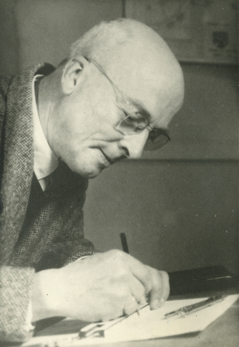
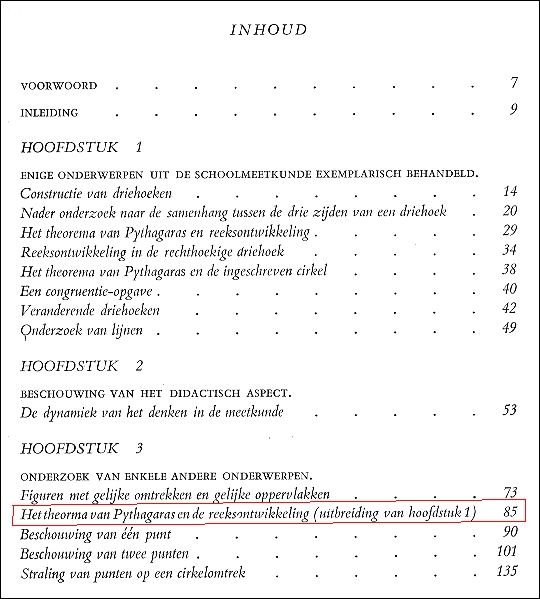
Chapter 3 contains Bosman's drawing of the Pythagorean tree and his discussion of some of its properties.

Bosman observes that the number of squares in the tree grows as 1, 2, 4, 8, 16, 32, 64, 128, 512, 1024, 2048, ... and states how the marvelous structure of the Pythagorean tree has a limit with "sharp lines and fine lace". He was well aware of the self-similar nature of his construction because he remarks how each square in the tree "can be considered as the original square, from which the tree is developed, so that it is made up of an engagement of uniform, smaller and smaller trees." Bosman was also interested in knowing "how high this tree is, how wide his crown at the top and in the middle, where the center of the curl points are located, etc." He used the following two diagrams to help investigate some of these properties.
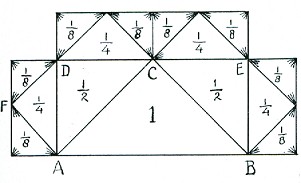
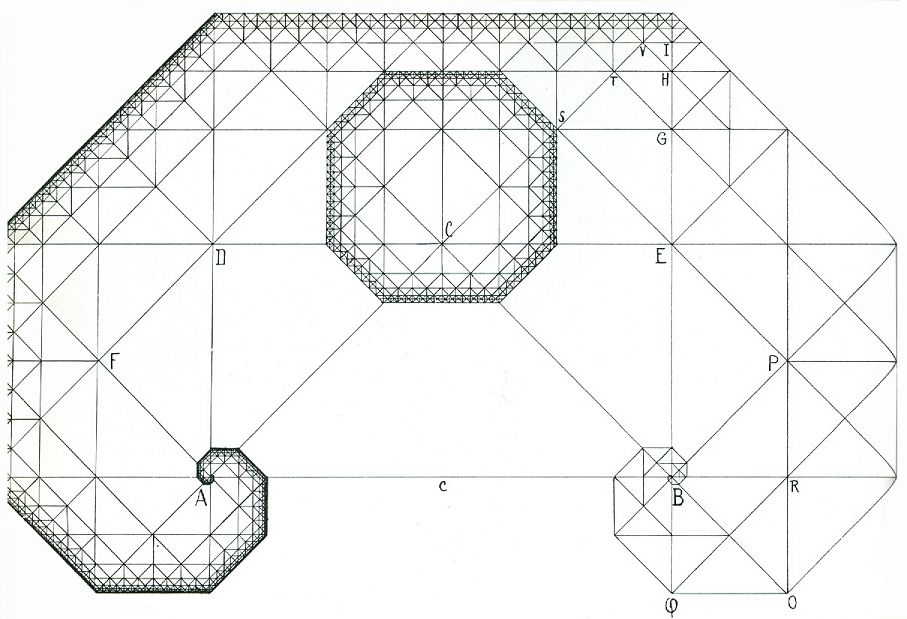
Bosman remarks that the bottom figure repeats the top drawing "to the infinitesimal." We can also see in the bottom drawing the basic construction of the Lévy dragon starting with the line segment AB.
In his book Bosman also demonstrates the development of the tree when using a non-isosceles right-angled triangle with angles 60° and 30°, a development Bosman calls "surprising".
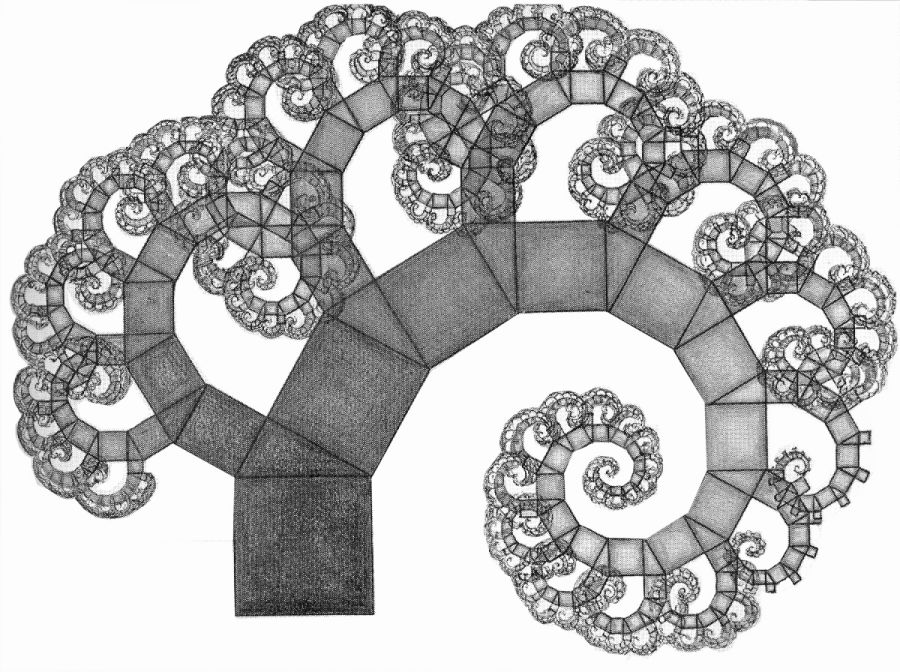
He finishes his short section on the Pythagorean tree by noting that there are all kinds of possibilities such as with the following figure in which the positions of the acute angles in the right triangle are switched at each step of the construction.