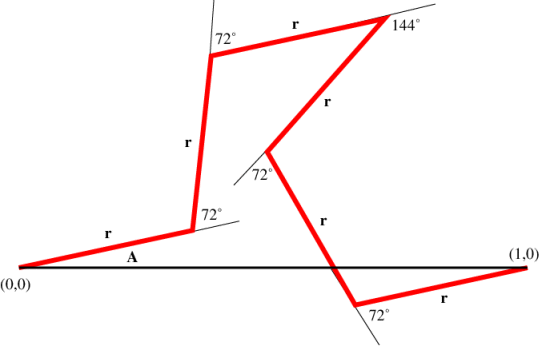
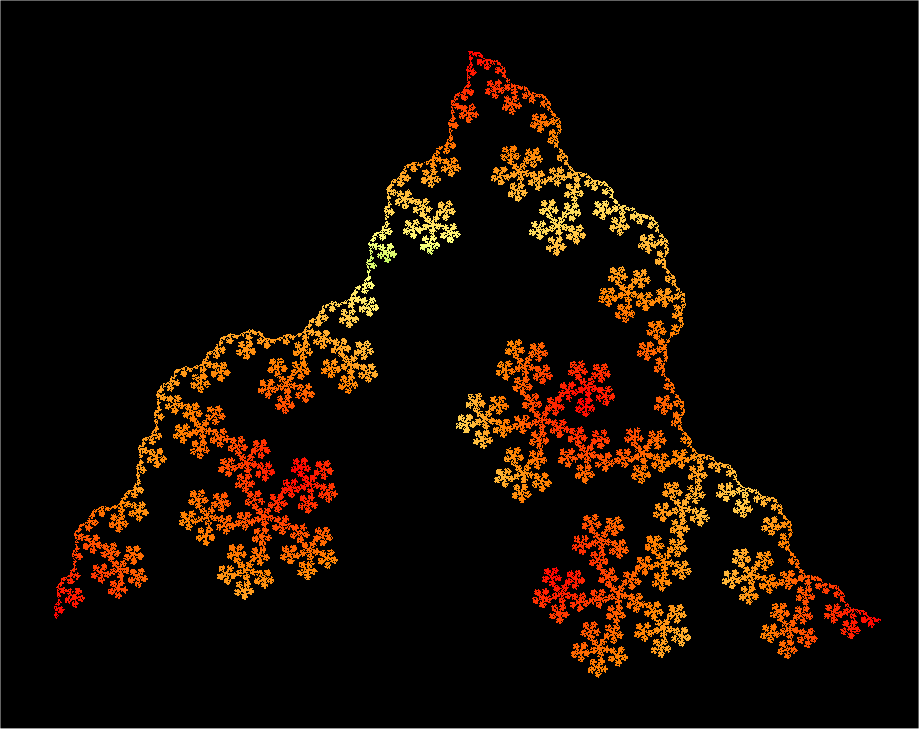
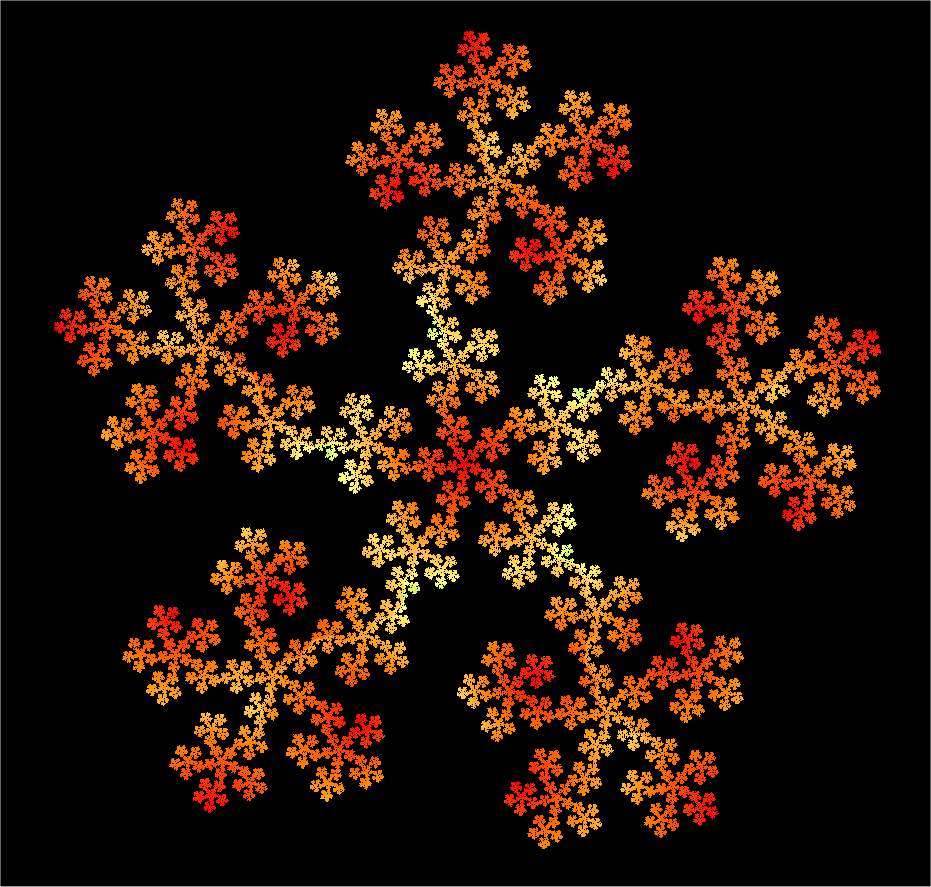
The pentadentrite is a variation of the
McWorter's pentigree. Starting
from the origin, draw a line segment of length $r$ at an angle
$A$. Turn left by 72° and draw another line segment of length
$r$. Next turn right by 72° and draw a third line segment of
length $r$. The remaining three line segments, each of length
$r$, are formed by making a right turn of 144° followed by
two left turns of 72°. The end of the last line segment will be
at the point (1,0).
The six red line segments in the figure give the first iteration
for this construction. The scaling factor $r$ and
the angle $A$ must be chosen so that the endpoint of the last
segment is at the point (1,0).
The following calculations show that \(r = \sqrt {\frac{{6 - \sqrt 5 }}{{31}}} = 0.34845\) and $A$ = 11.81858573°.
It is now possible to determine how each of the six rotated
segments must be translated. For example, the first segment must be
scaled by $r$ and rotated through the angle $A$. The second
segment is scaled by $r$, rotated through an angle of $A$+72°, then translated to $(r \cos A, r \sin
A)$. Similar calculations with the other segments led to the
following iterated function system [IFS Details]:
Angle 72
Axiom F
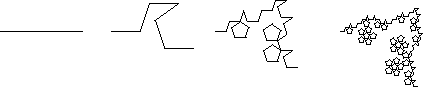
F —> F+F−F−−F+F+F
(this will be rotated from the IFS constructed curve)
First three iterations of the L-system
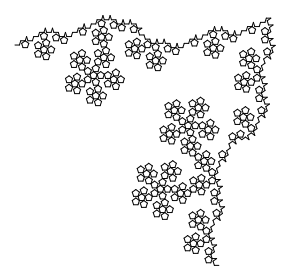
Four iterations
Similarity Dimension
The pentadentrite is self-similar with 6 non-overlapping copies of itself, each scaled by the factor
$r \lt 1$. Therefore the similarity dimension, $d$, of the
attractor of the IFS is the solution to