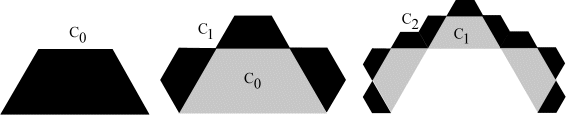
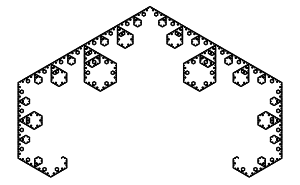
Instead of starting the construction with a isosceles right triangle, we start with an isosceles trapezoid $C_0$ with base of length 1 and the other three sides of length 1/2. Replace this trapezoid
with three scaled copies whose bases lie on the equal sides of the old trapezoid. Place each
new trapezoid so that it points out from the original trapezoid to get
$C_1$. For the next step, repeat the process on each of the trapezoids
that make up $C_1$ to get $C_2$, as illustrated in the figure below. Continue to repeat this construction on each of the scaled trapezoids.
Iterated Function System
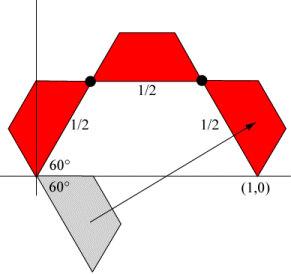
Suppose that the original trapezoid is placed so
that its base is the unit interval on the x-axis. The three scaled copies of this trapezoid are positioned as shown in the figure below.
The first scaled trapezoid must be rotated by 60°. The second scaled trapezoid is just translated so that the point at the origin is moved to the point \((1/4,\sqrt 3 /4)\). The third scaled trapezoid is rotated by −60° and then translated so that the point at the origin moves to the point \((3/4,\sqrt 3 /4)\). This yields the following IFS.
Angle 30
Axiom F
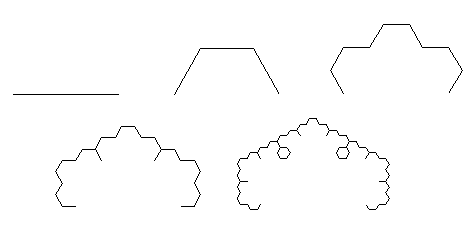
F —> ++F−−F−−F++
First four iterations of the L-system
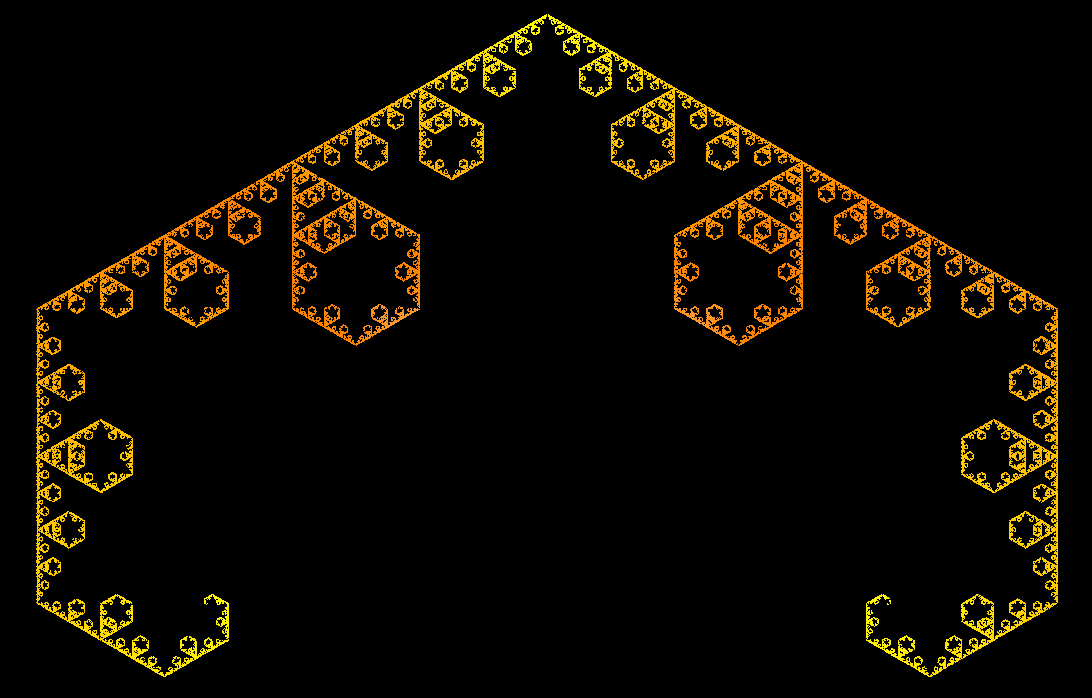
8 iterations
Similarity Dimension
The Lévy diamonds is self-similar with 3 non-overlapping copies of itself, each scaled by the factor
$r$ = 1/2. Therefore the similarity dimension, $d$, of the
attractor of the IFS is the solution to
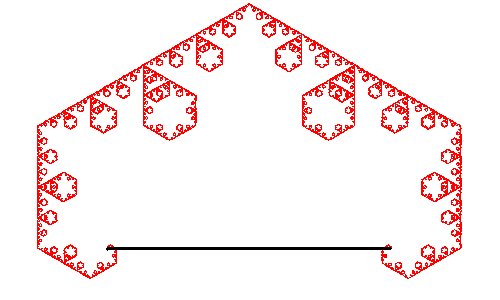
The L-system construction is the same as iterating the IFS starting with the unit line segment as the initial set. It is instructive to observe where the endpoints of the line segments in each iteration touch the fractal. Click on the bottoms to the left to see what happens during the first 5 iterations.
Iteration
References
Helmberg, Gilbert. Getting Acquainted with Fractals, de Gruyter Publishing, 2007.