The Sierpinski Carpet is Uncountable
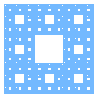
Let $S$ denote the Sierpinski carpet. The simplest reason why the Sierpinski carpet is uncountable is that the uncountable line segment $\{(x,0) : 0 \le x \le 1\}$ is contained in $S$. But we give two other proofs that $S$ is uncountable, the first using a one-to-one (injective) map and the other using an onto (surjective) map. Both make use of the ternary digit characterization of the Sierpinski carpet which says that $S$ is the set of all pairs \((x,y)\) in the unit square that have a ternary (base-3) expansion in which the ternary digit pair \((x_n,y_n) \ne (1,1)\) for every \(n\).
Proof via Injective Map
Let $ \Omega = \{0,2\}^{\mathbb{N}} $ denote the set of all infinite sequences $$ \omega = (\omega_1,\omega_2,\omega_3,\ldots), \qquad \omega_n \in \{0,2\}. $$ This set is uncountable.
Define a map $ F : \Omega \longrightarrow [0,1]^2 $ by $ F(\omega) = (x,y), $ where the ternary expansions of $x$ and $y$ are given by $$ x = 0.\omega_10\omega_20\omega_30\ldots{}_{\small{3}}, \qquad y = 0.0\omega_10\,\omega_20\omega_3\ldots{}_{\small{3}}. $$ Equivalently, $$ x_{2n-1} = \omega_n,\quad x_{2n} = 0, \qquad y_{2n-1} = 0,\quad y_{2n} = \omega_n \quad \text{for all } n \ge 1. $$
For every digit position $k$, at least one of $x_k$ or $y_k$ equals $0$. Hence the forbidden digit pair $(1,1)$ never occurs. By the ternary digit characterization of the Sierpinski carpet $S$, we have $F(\omega) \in S$ for all $\omega \in \Omega.$
To see that $F$ is injective (one-to-one), suppose $\omega \neq \omega'$. Then there exists an index $n$ such that $\omega_n \neq \omega_n'$. This difference appears in the $(2n-1)$st digit of $x$, so $F(\omega) \neq F(\omega')$.
Thus $F$ is an injective map from the uncountable set $\Omega$ into $S$. Therefore, the Sierpinski carpet is uncountable.
Proof via Surjective Map
Let $(x,y)\in S$, and write the ternary expansions $$ x = 0.x_1x_2x_3\ldots{}_{\small{3}}, \qquad y = 0.y_1y_2y_3\ldots{}_{\small{3}}. $$ By the ternary digit characterization of the Sierpinski carpet $S$, we have $(x_n,y_n)\neq(1,1)$ for all $n\ge 1.$ Thus at each position $n$, the pair $(x_n,y_n)$ belongs to the set $$A = \{(0,0),(0,1),(0,2),(1,0),(1,2),(2,0),(2,1),(2,2)\}.$$
Define a function $g : A \longrightarrow \{0,1\}^2$ by, for example: $$ g(0,0)=(0,0) \quad g(1,2)=(0,0) \\ g(0,1)=(0,1) \quad g(2,0)=(0,1) \\ g(0,2)=(1,0) \quad g(2,1)=(1,0) \\ g(1,0)=(1,1) \quad g(2,2)=(1,1) $$
We now define a function $ F : S \longrightarrow [0,1]^2 $ as follows. For $(x,y)\in S$ with ternary expansion pairs $(x_n,y_n)$, write $(u_n,v_n) = g(x_n,y_n)$ , where $u_n,v_n\in\{0,1\}.$ Now define the binary expansions $$ u = 0.u_1u_2u_3\ldots{}_{\small{2}} \qquad v = 0.v_1v_2v_3\ldots{}_{\small{2}}, $$ and set $F(x,y) = (u,v).$ The map $F$ is well defined because the forbidden digit pair $(1,1)$ never occurs in the ternary expansions of points in $S$.
We claim that $F$ is surjective. Let $(u,v)\in[0,1]^2$ be arbitrary, with binary expansions $$ u = 0.u_1u_2u_3\ldots{}_{\small{2}}, \qquad v = 0.v_1v_2v_3\ldots{}_{\small{2}}. $$ Since $g$ is surjective, for each $n$ we may choose a digit pair $(x_n,y_n)\in A$ such that $g(x_n,y_n) = (u_n,v_n).$ The resulting ternary expansions define a point $(x,y)\in S$, and by construction, $ F(x,y) = (u,v). $ Hence $F(S) = [0,1]^2$.
Since $[0,1]^2$ is uncountable and $F$ is a surjection from $S$ onto $[0,1]^2$, it follows that $S$ is uncountable.